Wednesday, March 4, 2015

Election 2015: Mulcair, the Reasonable One.

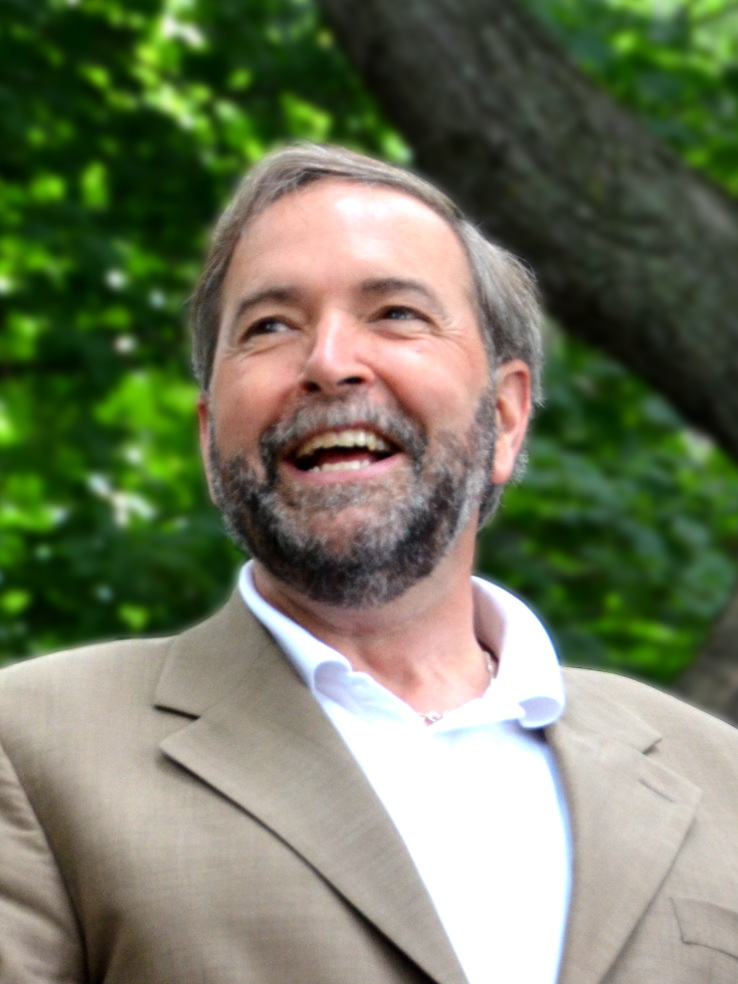
The Right Honourable Thomas Mulcair, remembering that time he was lambasted for saying Canada had Dutch disease, immediately before a report came out saying Canada had Dutch disease.  Source.
So,

I'm continuing on in my "Election 2015" series in [hopefully] one marathon writing session, with articles being released once every day or so.  The posts on the opposition opponents will probably be shorter, because they haven't been granted the opportunity to infuriate me nor drive me to angry blogging.  Yet.  Today's installment: Mulcair, the most reasonable guy in the room.  Also, Liberal until 2007.  Crazy, eh?

My Summary:

Mulcair has impressed me since taking the reigns from Smilin' Jack Layton after his untimely passing.  He's frequently featured on The House with Evan Solomon, and is often eloquent and measured.  That said, I'm most impressed by his work in Parliament, and the stories coming out of the House of Commons.  To wit:


Honestly, take the time to watch that video, he handles the situation brilliantly.  Further, this ultimately ended with a tearful apology from Paul Calandra and probably the death of his political career.  Also note that the second time Calandra deflected, he was given a standing ovation from his fellow Tories.  You'll also note a serious mis-step just after the four minute mark from Mulcair, he questions the neutrality of the Speaker of the House.  As it turns out, the Speaker does not necessarily have the power to compel Members of Parliament to answer questions, but it has led to a discussion of the role of the Speaker, and I would be glad to see more powers granted so that parliamentary discussion can be, y'know, useful.

With the exception of the last exchange, this is typical Mulcair.  After a marathon session of Parliament (I wish I had found an article which covered this, but I didn't), full of petty bickering and little progress, Mulcair ended the evening by essentially calling the lot of them a bunch of children, and adding that he hoped they would have a more productive day to follow.  I think his attitude will speak to a lot of Canadians who are fed up with the current pettiness of politics, and I think his is a good voice to have in Parliament.

Mulcair has also embraced his role as Leader of the Official Opposition.  Unlike his predecessors (except perhaps Ignatieff, who took a similar tack), he has been measured, not getting spiteful, but has also been persistent.  He makes an effort to hold Harper to account whenever he feels attention is warranted.  Though he has no political leverage in the House, his work frequently finds the ears of Canadians and can lead to change from public pressure, because it seems the only way to sway Harper is if his polling numbers are significantly threatened.

Most recently, I seem to recall Mulcair being concerned at the prospect of mission creep in Canada's role in the air strikes against ISIS targets.  I could be wrong, but I [think I] specifically remember them because I thought it was an unreasonable concern.  We would be involved in air strikes and potentially training, and there would be a six month review.  However, Canadian Forces now find themselves on the front lines of battle.  Mulcair is active in demanding an explanation of the governing party, though we are roundly assured that Canada is not in a combat mission, it's just that they're training from the front lines, and they have to defend themselves if fired upon, don't they?

Something to think about.

My Verdict: 

Mulcair is, quite possibly, the only [or perhaps, most] sane person in the House of Commons.


My Prediction:

Mulcair should probably win this election, but he won't.


NM

Other posts in this series:
Harper, the Proroguer
Trudeau, the New Kid

Monday, March 2, 2015

Election 2015: Harper, the Proroguer.

Prime Minister Harper, remembering the days of high oil prices.  Source.
So,

After almost four whole years after the Tories took power, we are once again in an election year.  I'll admit that I'm pretty excited at this prospect as a fan of evidence-based practices and a proud Canadian that has been repeatedly exasperated by the elected representatives of my countrymen.  Particularly that second one, under "exasperated."  It touches on the most mind-bending of Harper's offenses, though my writing is excessively verbose.

I thought it would be an interesting exercise to record my thoughts on the candidates going into this election, including what I think of each candidate, and where I think they'll end up after election night.  That way I can look back at what my exact thoughts were (as can all of you, my be-monocled, top-hatted readers), and reflect on how truly wrong and misguided I was.

My Summary:

So, Harper the Proroguer.  I've been thinking a lot about it this week, and I cannot decide whether he is willfully blind to evidence, an excellent politician, a fool, or all of the above.  In all seriousness, I believe he must be doing what he thinks is right, I don't think he's doing anything with deliberate malice, but he just keeps doing such goofy things.

Take for example the census.  Canada was a world leader in excellent census data, particularly because it was mandatory.  Prison sentences actually awaited those who refused to fill out the long-form census.  Harper publicly decried these penalties and removed them in one of his first acts as the leader of a majority government.

What's my problem with that?  Well, I'll say first and foremost that it wasn't an issue.  It's almost like his movement to change the lyrics of 'O Canada' to be more gender-inclusive.  It just wasn't being discussed.  It wasn't on anyone's radar.  It's like he saw a peaceful beehive and decided to stick his finger in there to see what would happen.  It's like he's the Joker of political action, just an agent of chaotic destruction.  Anyway, it didn't matter to him that nobody in the history of the Canadian census had ever gone to prison for not filling out the census, because no reasonable person would ever choose prison over taking ten minutes to half-ass the long-form census.  So now we have a voluntary survey.  That's great.  How does the government now make decisions on how to best deliver public services?  Probably based on questionable data.  Or purely political motivations, knowing Harper.

After the Tories fought tooth and nail for these things, it turns out they don't even work in the Arctic.  But they are, and will always be, Scandalicious. Source.

However, this could also have been a brilliant calculation.  The economic situation hasn't been great since the Great Recession of 2008, and who is least likely to fill out the voluntary survey?  According to Ivan Fellegi, former Chief Statistician of Canada, it's the poor, new immigrants, and aboriginals.  Those who, in general, could benefit most from public services, and those who are most likely to deflate Canada's economic picture.  This is pure, baseless speculation, but it would be a brilliant political move.

So that's a thing that happened.  Harper also came to power promising more government accountability, appointed a Parliamentary Budget Officer to fulfill said promise, and then dismissed the unfortunate Kevin Page when, y'know, he tried to hold government to account.  Which was his job description.  And the job was created for that purpose by Harper.  Harper wanted to reform the Senate and make it more democratic, and then a bunch of his senate appointees were unceremoniously ousted for their unethical behaviour.  He referred to a non-confidence motion to defeat his government as a "parliamentary trick" when that's how he himself came to power (or that's how I remember it anyway).

He's an interesting character.  Bewildering, but certainly entertaining.

My Verdict:

Petulant politician, perpetually pining for power.

My Prediction:

... Isn't really much of a prediction.  Those who have been paying attention for his tenure are mostly sick of his antics, but most electors either 1) haven't been paying attention, or 2) vote Tory out of principle, and are probably over the age of 55.  He's got a solid support base.  Further, if Mike Duffy's allegations that Harper ordered him to pay back his expenses because, quote, "it is inexplicable to our base," he certainly does a lot of his maneuvering with his supporters in mind.  I think Harper has it in him to win again with two "unproven" rivals.  If he wins it'll probably be a minority, and if he loses he will almost certainly limit the winner to minority status.

NM

Other posts in this series:
Mulcair, the Reasonable One
Trudeau, the New Guy

P.S.  In the lead up to this, I watched a bunch of old Rick's Rants.  You might enjoy them too, so they're posted below.  Also following is a link from the hilarious Scott Feschuk on Stephen Harper from 2013 conversing with his 2005 self.

http://www.macleans.ca/authors/scott-feschuk/its-so-good-to-talk-to-me-again/

Saturday, January 31, 2015

Pipelines. [EBP7]

The Alaskan Pipeline.  Source Ryan McFarland.
So,

I tried to fiddle with my blog layout, so hopefully you'll see more photos in their original size.  As it turns out, the average computer monitor isn't quite so restricted as it was when Awesome, Inc. designed this template, and it's nice to be able to show pictures in their original size and splendour.

But yes, to the point.  The Keystone XL pipeline has been approved by the United States' Congress and President Obama has vowed to use his veto.  I'm also hearing a lot about the Energy East pipeline, which is currently slated to ship Alberta and Saskatchewan oil as far east as Cornwall, Ontario.  Specifically, it will deliver crude oil to refineries in the East.  Tom Mulcair has actually been a vocal proponent of upgrading our raw natural resources before exporting them, because it means more Canadian jobs and increases the value of our exports.  It seems much better than exporting our oil to be refined in other countries, so that we may buy it back at a higher price, anyway.

But still I digress.  Pipelines are all over the news, and there is a lot of resistance.  Tonnes of it, even.  In fact, there exists a pipeline known as "Line 9" that runs from Sarnia to Montreal.  In 1976, it carried oil eastward, I am assuming in the wake of the OPEC oil crisis.  In 1998, the flow was reversed to ship the cheap oil from across the Atlantic inward.  And now, again, the flow has been reversed to supply Western crude to the East.  The amount of resistance and complaints this faced was astounding given that the pipeline was already in place.

So pipelines are so unpopular that even those which exist are subject to intense scrutiny for simply reversing flow direction.  Pipelines which are to be constructed face even more intense criticism.  And I will grant that this is at least partially warranted.  Pipelines are subject to failures which can release non-trivial amounts of crude oil into potentially sensitive environmental areas.

But here's the thing: Canada is addicted to oil.  The world is addicted to oil.  Since the Industrial Revolution, we have been burning and using fossil fuels, and it has shaped our lives in ways most people don't realise.  All your plastics are petroleum products.  Polar fleece sweaters are made from petroleum.  Drugs and the solvents used to develop them are often based on petroleum products.  But the biggest use of oil is for energy, and energy is the biggest industry there is.  If liquid fuels are included, it is the biggest industry by several factors.  To quote Rick Mercer, that's alotta poutine.

So we're addicted, and it's big money.  Money so big that Canada's dollar is under 80 cents USD, down about twenty cents since the price of oil dropped precipitously.  Money so big that the oil will be shipped, regardless the approval of the pipelines people protest.  And what happens when pipelines get blocked?  Well, Lac-Mégantic happens because the oil needs to be shipped and, shockingly, CN and CP are more than happy to make money transporting things to port.

Intermodal Safety in the Transport of Oil, from the Fraser Institute.
So it seems pretty obvious that the money at stake ensures the extraction and transport of available oil.  Now consider the above figure.  Pipelines are at most half as risky as transportation by rail (when adjusted for the amount transported), and these numbers are from before the crop of recent derailments.  So if one truly wishes to stop pipelines, one must get humanity off of oil.  Stopping pipeline construction won't alleviate climate change, because the oil will get shipped by more dangerous means, only putting more lives and environmental areas at risk.

I don't think oil is in the far future for humanity, oil being an unsustainable resource, unlike nuclear and hydro.  But we are addicted.  When OPEC cut off the supply of oil to North America, things got really bad really quickly.  We need to find alternative sources of transportation fuel (or batteries), but it won't change overnight.  So as long as we need oil, we should ship it by pipeline.  It's cheaper and safer than the alternatives.  Well, except maybe for filling water bombers with oil.

NM

Thursday, December 25, 2014

Torture [EBP6].

This document has come to be known colloquially as the CIA torture report.

So,

Merry Christmas!  This isn't at all a festive topic, but it's been on my mind lately, and I've stumbled upon some free time because the people with whom I am spending Christmas don't share my 07:00 start time.  Half an hour ago I discovered the hidden pickle ornament which shall entitle me to the "Pickle Present," when everyone else is awake, and now I'm bored.

Many nation states have tortured prisoners in an attempt to gain intelligence in the past, and I'm sure many will into the future.  Islamic State militants are currently torturing their prisoners using the "waterboarding" technique in an act of vengeance (though I'm sure they would have it framed as reciprocity).  After the attacks of September 11, 2001, United States operatives utilised what have come to be known "Enhanced Interrogation Techniques" (EIT) which bear a striking resemblance to what the rest of the civilised world would call "torture."  I'm not going to get into the details, because that isn't the point of this post.

Torture is sort of a heavy topic, so here's a picture of a puppy.  This scruffy fellow's name is Sawyer.

In a move that I am going to applaud, the US Senate reviewed and then publicly disclosed the results the use of EIT, and it's not good (you can find a good summary here).  The long and short of it is that  it did not work nearly as well as had been hoped or represented by the CIA.  Frankly, this doesn't surprise me either.  Part of first year psychology classes includes the lesson that torture doesn't provide useful information because, when under that level of duress, people will say anything to make the pain stop.  This is more or less what was found by the Senate Committee, though the CIA asserts that a known courier to Osama bin Laden was named after the use of EITs on a detainee.

Torture makes for exciting television or movie storylines, and it seems to appeal to a "common sense" notion that hurting people will force them to give up useful intelligence, but in practice it doesn't really work.  Any careful organisation will enforce a "need-to-know" system in which most detainees wouldn't have any useful information anyway.  

That question remains, however, how do you acquire intelligence from a prisoner if not through torture?  They're not supposed to tell you useful information after all, so what do you?  Well, here's a novel, Chistmas-y idea: try being nice to them.  The most interesting sources which I have come across on this topic were in psychology lectures (which might be misremembered, it might be in the text), and in the book "The Defence of the Realm," the authorised history of MI5.  The only source I could easily Google can be found here, and mirrors what I've read elsewhere.  In essence, if you treat a person as hostile, they're less likely to co-operate with you.  If you tell them honestly that they are no longer a combatant (because they aren't), and if you express genuine empathy for their situation, they're far more likely to co-operate.  As mentioned in the source, Hans Scharff was an interrogator for the Luftwaffe in World War II.  He was so successful that some of his US prisoners were tried for treason after the war  because he had gotten so much information out of them.  That's how successful you can be when you don't act like the evil enemy you might be portrayed as.

When I come downstairs in the morning in Belleville (this was taken when I was recovering from hip surgery), Bailey comes to see me and we have a "chat."
It's also worth noting that, though the Republican Party does not widely condemn the use of EIT, prominent Republican John McCain does.  He specifically states that torturing detainees compromises "...that which most distinguishes us from our enemies.  Our belief that all people, even captured enemies, posses basic human rights."  He's absolutely correct.  Specifically now, when Islamic State militants are being condemned for their inhuman acts, it's difficult to maintain the moral high ground while actively torturing prisoners.  So going forward, let's all remember the Christmas spirit, and engage in the evidence-based practice of not torturing people.

"By the way," you might ask, while polishing your monocle, "why did John McCain come out so strongly against torture when the rest of his party did not?"  It probably has to do with the fact that John McCain was tortured in Vietnam.

NM

Suggested reading/watching:


Tuesday, December 9, 2014

The ideal wedding ring.

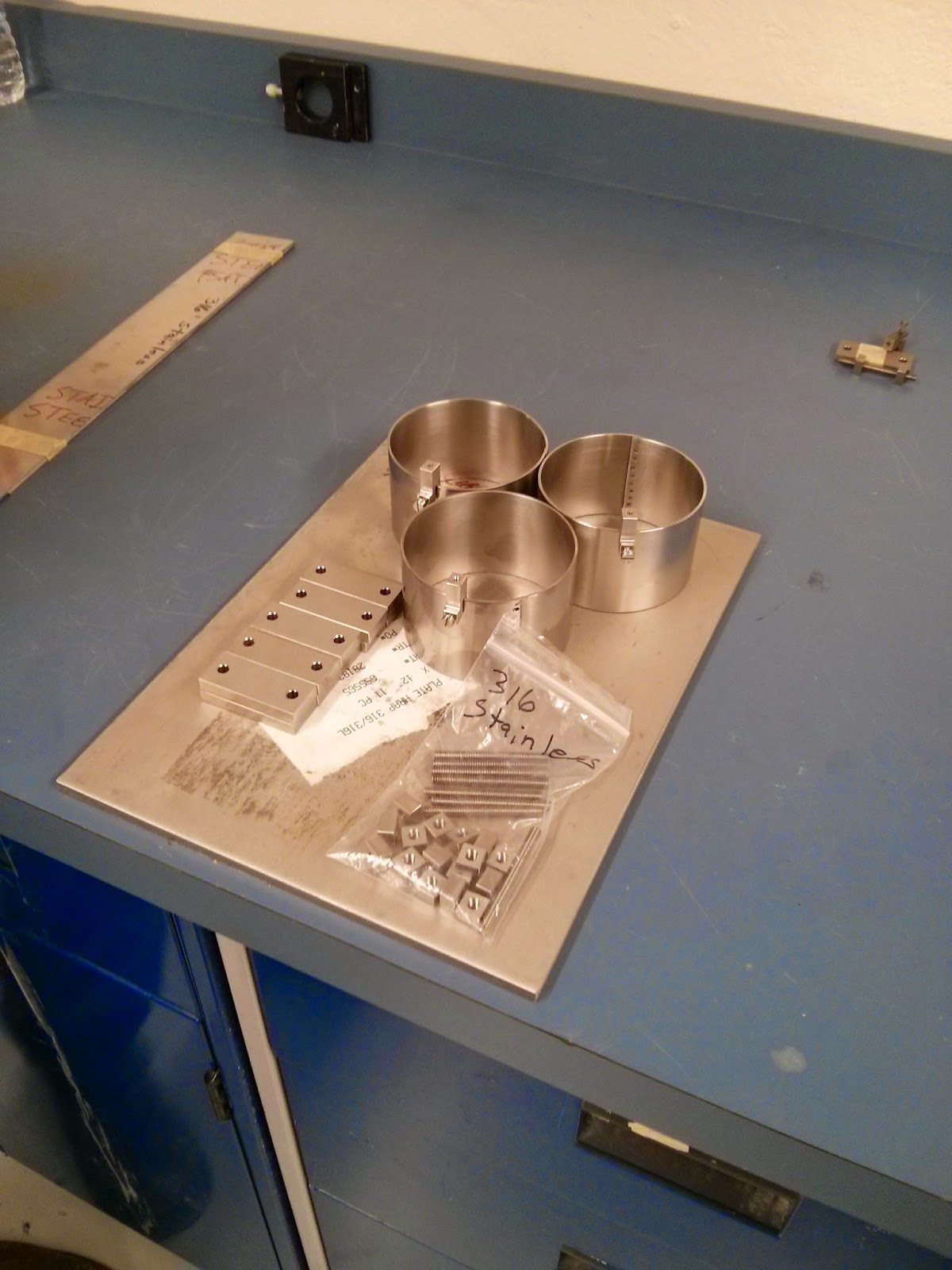
What a couple hundred dollars' worth of machining and grade 316 stainless steel looks like.

So,

My mind has been thoroughly wandering lately, and it settled upon an interesting thought experiment a while back: what is the ideal wedding ring?  It appears that I have followed CGP Grey's model, and got so excited about my idea that I wanted to talk to everyone about it, ran out of real-life people who would listen to me, and decided to talk to you, my dear, monocled, top-hatted, stylish, and not at all robot audience.

I'll start by saying that I don't actually judge the choice of wedding rings of others, different types and styles please the eye of the wide variety of people out there.  If your ring makes you happy, I'm happy you're happy.  That said, ladies, pay attention.  If you wish to lock up a man like me (and who wouldn't want that?), you'll need to consider the following.

The standard wedding ring is one or several diamonds mounted on a gold band, both materials of variable purity.  Diamonds specifically have an interesting series of characteristics upon which they are judged, and different impurities will impart different colours to the stone.  Gold, also, will have a variety of other elements present, and its purity is expressed in carats (or 'karats'), because what humanity really needs is another useless unit that could easily be expressed as purity by weight or atomic percentages.

Pictured: an affront to basic human decency and logic.  Source.
 
Diamonds specifically are a source of ire for me and fellow logical, beautiful man Rob.  To understand why, one must first appreciate many of the world's diamond mines are run by De Beers, a cartel which was close to a monopoly, and maintains generally shady business practices.  This includes withholding stockpiles of diamonds and limiting supply to create an artificially high price, flooding the market with diamonds similar to its competitors to drive them out of business, and keeping a limited, approved number of purchasers.  Generally, diamonds are not worth nearly as much as we pay for them because the supply is deliberately limited.

Further, the diamond ring as a wedding/engagement ring was a product of marketing in the early twentieth century.  Where wedding or engagement bands would often feature gemstones like rubies (because rubies are red, and red so obviously equals love), it was drilled into the consumer that diamonds were forever, and families were encouraged to purchase them to use as valuable heirlooms (despite the fact that the resale market is horrendous).  Young women especially were told to expect a diamond if the chap in question really loved her, and the films of the time ended up featuring many a luxurious diamond.

So diamonds.  They're not worth nearly what we pay for them, and the reason we expect them is entirely due to marketing.  And on the note of marketing, specifically that which says diamonds are forever.  Diamonds are less energetically stable than graphite (the stuff in your pencil), and over the course of the universe, diamonds will slowly but surely decay into graphite.  Not at all the symbolism you want in a wedding band.

Now, let's tackle gold.  Gold is known as a noble metal, it is quite unreactive and as a result can be found in veins underground in its natural state.  This is quite unlike the more reactive metals like aluminum (or aluminium, if we're sticking to IUPAC standards) which can be found almost exclusively as a mineral which requires refining to reduce to a metal.  Human beings have long prized gold for its shininess, the fact we can find it in its natural state, and its malleability (the pure stuff is very soft, which is why you see Olympic athletes biting their medals).  In fact, these all make gold useful for coins, and that's basically why we like gold so much.  Its resistance to corrosion and good conductivity make it useful for electronics, and it has some fringe uses in chemical catalysts, but that's about all the uses that gold has for us.  In an excellent episode of The Invisible Hand, they discuss the relative merits of gold and chickens as currency in a post-apocalyptic society.  A conclusion of the show was that gold is only valuable because it has been so intrinsically tied to coinage and worth for so long, its value is almost entirely ascribed.  Frankly, it might as well be a tulip for all the good it does us.

Aqua Regia.  Source.


An interesting consequence of gold's nobility is that very few things can dissolve it.  Aqua regia is one such acidic mixture, hydrochloric acid combined with nitric acid.  In fact, there's a neat story in that Wikipedia post about some Nobel Laureates fleeing prior to Nazi invasion.  A Hungarian chemist named Hevesy dissolved the gold medallions in aqua regia so that they wouldn't be discovered, and after the war he returned to find the solutions untouched.  The gold was recovered, and the medallions re-struck.  But I digress.  Gold dissolves in only a few things, and aqua regia is one of them.

This, of course brings me to the ideal wedding ring material: stainless steel.  Stainless steel is built on the foundation of steel, iron combined with just enough carbon to make it hard and durable.  Stainless steel is quite a hard metal, very tough, very durable.  This is combined with various amounts of chromium and molybdenum to protect it from corrosion.  Specifically, as steel undergoes corrosive attack, the iron will be eaten away with comparative ease, but the chromium and molybdenum will not.  They will remain and gradually build a resistant layer which will protect the integrity of the base material.  It's not unlike a marriage, really.  It's a bit vulnerable in the beginning, but it gets tougher and more protected the longer it lasts, the more tests it faces.

Axes titles say it all, really.  Source.


And, to deal with the idea of "forever."  Above is a figure depicting the average binding energy per nucleon (a proton or neutron) vs the number of nucleons in a nucleus.  You'll notice that right up at the top there, you have iron.  The long and short of this figure is how much energy is holding a nucleus today.  The elements at either side of the chart, hydrogen and uranium, are both nuclear fuels and will release tremendous amounts of energy, particularly when in bomb form.  Iron, however, will not.  Iron and nickel are two of the most stable elements in the universe.  Nickel is only slightly more stable, but apparently is less abundant because of the mechanisms which nuclear reactions follow.  Despite being more stable, it's easier for stars to fuse the elements into iron than nickel.  Isn't science neat?

So, let's talk about how long forever will be.  The universe will meet one of three ends: it will expand until it falls back upon itself; it will expand to a point where it eventually stops and rests; or it will expand into infinity for all of time.  My two cents is that the first scenario (the heat death of the universe), doesn't seem terribly likely given that the universe's expansion is accelerating.  The other two scenarios will end with the universe expanding and cooling until it meets an icy end.  The only way that iron is converted into a heavier element is if it is found in the heart of a star before a supernova.  Explosive star death is the source of all the elements heavier than iron, because energy is required to fuse these more massive elements.  As the outer layers of a star collapse upon its core, the tremendous heat will fuse the heaviest elements and the explosion will fling them outwards.  So unless your wedding ring finds itself in the heart of a supernova (unlikely), the iron from the steel will last into the most literal form of eternity that we can comprehend.

So what have we learned?  Diamonds are locked in an artificial market, will gradually decay into graphite, and are only strongly desired because of strong marketing.  Gold, similarly is only as valuable as it is because we lose our collective minds when we see sparkly things.  Even at the end of that episode of the Invisible Hand, they ask the proponent of gold for his thoughts after explaining the actual value of gold, and his answer basically amounted to "Well, if you're not going to use gold as a currency, what else are you going to use?"  Stainless steel, in contrast, is more than skin-deep beauty.  It is much tougher than soft gold, and it will last the test of time much better than gold.  And speaking from experience, the grade 316 stuff will resist even boiling aqua region for all its worth.  I've spent hours trying to dissolve small filings of it.  That's the kind of symbolism you want in a token of love to one another.

NM
UA-57182519-1