Saturday, February 2, 2013

[Old MacDonald Had a Farm] EROEI

An explosion from nuclear test Operation Upshot-Knothole.  Simon, to be specific.  Source.

So,

You have my apologies for the delay in exploration of fascinating [read: "mildly interesting"], topics.  It would seem between a laptop dying and a lack of night shifts, I don't have the large of chunks of time to properly discuss [read: "write until I get bored"] the issues which I feel you, dear monocled reader, deserve to know about.

The topic of this post is EROEI, an acronym for Energy Return on Energy Invested, also known as EREI, but if you have the extra O, it ends up being more like the Old MacDonald song.  In either case, I believe that our future prosperity as a species hinges upon our ability to effectively utilize renewable and sustainable energy sources, for reasons I will get into later.  That being the case, we need to consider EROEI when evaluating energy sources to determine their viability.

For some context, let's think about oil.  Since the first "gusher" was discovered in Texas, we have gradually been tapping all the easy oil we have been able to find.  After a while, there were no gushers left and we had to work to get the oil out of the ground.  This has continued ad absurdum because we have built an infrastructure for ourselves that runs on oil.  Those first gushers received their name for a reason.  For the equivalent energy of one barrel of oil (just above 6GJ of energy, 42 US Gallons), 100 barrels were gathered.  So we put a little energy in, and got it back one hundredfold.  In 1970, the efficiency of oil imports to the US represented an EROEI of roughly 40.  By the late aughts, it was closer to ten.  The oil from the Canadian tar sands can be extracted for an EROEI of roughly three.

This means that the efficiency of oil has decreased significantly for us.  We have gone from getting energy back one hundredfold for our efforts, down to about three times in northern Alberta.  This actually represents my biggest issue with oil going forward.  We have plenty of oil reserves from which we could draw for decades to come, but the problem is that we are approaching a point where the EROEI for oil will reach 1, and decline from there.  This would mean that it wouldn't actually be worth our time getting oil out of the ground, because the work we perform to extract the oil would be greater than the energy in the oil we extracted.

To attempt to put this in perspective, I'll talk about first generation biofuels (I provide this link knowing full well that you, my dearest top hatted reader, remember the post vividly).  In order to make ethanol out of corn in Canada, the EROEI represents between about 0.8 and 1, if I recall correctly.  That means that if you consider all the energy the farmer/factory worker spent in gas and fertilizers to grow, harvest, then convert the corn to ethanol, we would have been further ahead to just burn the gas directly and skip the ethanol fiasco.  Naturally, the legislation surrounding first-generation biofuels is really intended as a stepping stone to get to second generation biofuels, which will have an EROEI well in excess of 1, and probably greater than that of the tar sands.
You've been reading a while now, so here's a picture.  It's not switchgrass, but it sure is nifty.

In my article on switchgrass [my favourite biofuel candidate], I point out that the EROEI for growing and then burning switchgrass is roughly 20 [though I wasn't aware of the concept at the time].  For growing, converting to liquid biofuel and then burning, the EROEI is hypothetically around 5.  To put that into context, that means that in terms of energy, we would be further ahead making biofuels out of switchgrass than getting into the tar sands debacle.  Simply growing and burning switchgrass for heating purposes puts the tar sands to shame, and makes a mockery of home heating oil [in terms of energy, of course].  Why don't we do this?  Sure beats me, I assume it's some combination of an unwillingness to invest in new technology (and changing existing infrastructure), and distorted economics due to government subsidization of the oil industry.

Now, I assume at this point your are adjusting your monocle and top hat, and saying "I'm sure enjoying this talk of ratios, but could there be broad, global implications from falling EROEI?"  I'm glad you asked, dear reader.  Historians have hypothesized that a contributing factor to the downfall of the Roman Empire was falling EROEI.  The Romans, as it turns out, were not terribly good at soil conservation.  As time went on, the amount of food that Roman crops produced declined with the quality of the soil.  I am quoting a friend Paul on this, but I am told that great tracts of fertile land were reduced to desert, land which has never recovered.  Naturally, there were economic consequences to this, and the Empire declined and fell*.

It has also been pointed out that energy prices (which are somewhat reflective of EROEI in absence of ridiculous market forces), are intimately related to economic strength.  Every time there has been a sudden spike in the price of oil, an economic downturn has followed.  With falling EROEI of oil, I don't believe it's unreasonable to expect economic consequences from our continual dependence on oil.

At this point, I'm sure you're wondering what some good alternatives would be.  While nuclear explosions yield a fantastic EROEI (the picture at the top WAS related after all!), current nuclear reactors can offer an EROEI of roughly 10 and thorium reactors of the future (maybe a post-worthy topic), could yield 50.  What about wind and solar?  Well, wind offers an EROEI of 18, and solar 6.8 [though focused research is aiming to improve that figure].  I'll point out here that EROEI for wind and solar refers to the energy generated over the lifetime of the equipment divided by the energy required to manufacture the equipment.  You'll notice that even though these figures are low, they're all higher than the 3 we get from the tar sands.  That being said, it sure would be nice if we still had a sustainable power source which yielded an EROEI of 100.

Wait, hold on, there's something about that figure that's familiar...

Ah, yes.  We have an energy source like that.  It's hydroelectricity.

NM

* - No, I'm not saying that this is the only reason that Rome fell, but I'm saying it was likely a contributing factor.  The same work producing a smaller product is bound to have consequences on that grand a scale.

P.S.  This turned out pretty messy, I'll maybe edit this later.  Hope you got this far and/or enjoyed it!

Sunday, November 4, 2012

Under-Utilizing Resoures, and the Paradox of Thrift [EBP 3].

Cryptic, yes, but read on.  Source.
So,

My posts often fall into one of two categories: there's something I've learned about and wish to inform/discuss with others, or something that irritates me and I want to rant.  I suppose this post will be a partial mix of the two.

It's hard to say exactly what is happening in the economy right now.  There are constantly indicators which look promising (and Canada's Government makes great strides to ensure you know this), but at the same time we face persistently high rates of unemployment, with the 18-35 demographic particularly hard-hit.  I personally found myself unemployed for the entirety of last year (though for four months, I was a part-time student), and was particularly discouraged when I could not even get a call-back for a job loading and unloading trucks.  Luckily, I found a job.  It's round-the-clock shift work, but I have a steady paycheque, and that puts me way ahead of most of my peers.  That said, shift work is certainly not my ideal career end-game, and I work with a lot of people who are not chemists by education.  I don't want to work there forever and ever, but with the job market the way it is, I can't fathom leaving.

The job market is currently a tough place to find yourself in, and most economic indicators still put us in "challenging" territory.  You'll also hear a lot of corporations and government talking about belt-tightening, reigning in budgets and taking austerity measures [exactly what the first two terms meant, but it sounds fancier].  However, and feel free to correct me, this appears to be the exact opposite of what everyone should be doing.

After gaining a casual interest in economics, I have come across the concept of the Paradox of Thrift.  You see, times are tough, and our base instinct is to save money.  We put off buying that shiny new tech item, new vehicles, and men's undergarments [I'm not kidding, it's an important economic indicator].  So people throw money away into savings accounts, fearing a rainy day.  Corporations too, will keep large sums of money, fearing the worst.  Governments which spent heavily on stimulus cut back on spending in an attempt to balance budgets.  It all seems perfectly reasonable, and it is helping no-one.  After all, saving money only keeps it out of circulation.

When considering the general population, saving seems a little more understandable.  These are individuals, and in challenging economic times it seems reasonable that jobs could be lost and with it, one's entire revenue stream.  It also seems reasonable with corporations, though the problems become more pronounced.  The Guardian has published an article which is very much par for the course when reading about corporate wealth in 2012.  Corporations are currently sitting on historic* amounts of cash.  Some of this is being paid out to investors in the form of dividends.  Unfortunately, since most people invest in companies as a form of savings and not income, this money doesn't end up in circulation.

[* - I have no idea if this figure is historic, I think I heard this used at one point, though it may have been exaggerated or misremembered in my own mind.]

So what does this leave us with?  Governments spent, and are still spending, large sums of money in hopes to kick-start the economy. In my post on Government stimulus, I gave an example of how Government spending can mitigate downward economic trends and help recovery.  I have since learned that this can be somewhat compounded by the Keynesian concept of the multiplier.  When the Government injects cash into an economy by way of spending on public works, the workers now have money which is spent on goods and services, mostly locally.  Those secondary beneficiaries of Government spending are then free to spend more, creating tertiary beneficiaries of the stimulus, and so on.  Keynes [or rather, his protege Kahn, I think], originally estimated that in Great Britain, at the height of the Great Depression, each dollar of government spending would represent two in circulation because increased monetary circulation.

So corporations have benefitted from government stimuli, and are reaping in large amounts of cash.  Now, normally one might assume that the corporations could then invest that money in hiring new employees, who then have money to spend.  This is the way to recovery, and the current reality may be the reason the global economy is still sluggish.

Having just recently graduated, I can see the effects of this corporate stinginess first hand.  I know both people with what I would regard as a more general skill-set [Arts majors who are then qualified to work in almost any business environment], and those with very specialized skill-sets [STEM jobs, Science, Technology, Engineering, Math].  These people, all of them, are capable of generating vast amounts of wealth with their expertise.  This may be through their unique skill sets, their dedication [evidenced by a Bachelor's degree] and work ethic, or all of the above.

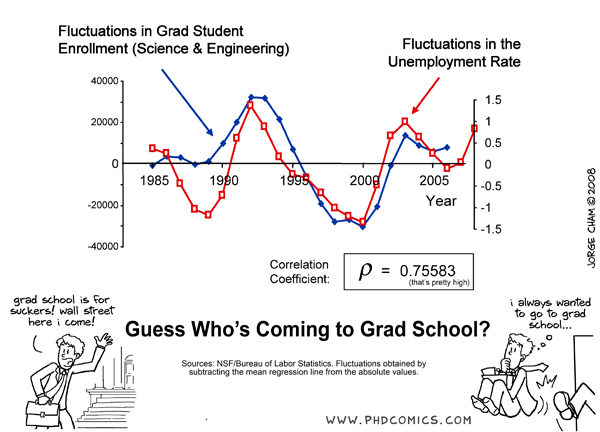
So where are these potential wealth generators?  I know, and have heard of, advanced degree holders working at Denny's and Lululemon.  I know a receptionist.  I know several people who are unemployed outright.  I know others who have retreated back into graduate school in order to earn a paycheque [and it's a trend, see this comic]:
As an aside, this is a really excellent comic strip.


When I see this happen, I see an under-utilization of our nation's resources.  These people are ready, willing, and able to do more.  These people are capable of generating new wealth for the private sector. These people can balance troubled government budgets with increased personal and corporate tax revenue.  By sitting on these vast piles of cash, corporations are causing the very uncertainty they are trying to protect themselves against.

NM

P.S.  "Code Red" by Delhi 2 Dublin was an excellent song to listen to while writing that final paragraph.

Thursday, October 18, 2012

Eggs, and Things [the Media Says] Scientists Say.

An egg.  I usually make mine over easy, but this is okay too.  Source.
So,

It is all over the headlines recently.  Eating egg yolks is as bad for you as smoking.  An egg yolk is equivalent to five kicks to the groin.  The Ministry of National Defense has begun studying mechanisms by which egg yolks could be weaponised.  Scientists postulate the dinosaurs went extinct from eating too many cholesterol-filled eggs.  For the record, I can't believe that any of these statements would be published, but fire up Google, and see for yourself.  I'd like to give my two cents on the matter, and hopefully offer some clarity to my tens of regular readers (by the by, I'm sure you're looking quite dapper in top hat and shined monocle).

The contention of these articles, and the University of Western Ontario's medical study, is that eating eggs (with yolks), and smoking are roughly equivalent in terms of the damage they do to your arteries.  The primary criticism (and I can't believe only this is the primary criticism), is that eggs and cigarettes damage arteries in completely different ways.  Cholesterol (which eggs contain) causes plaques to build up on arterial walls, while smoking inflames arterial walls.  The effect is ... roughly  the same.  I would like to levy a series of criticisms, if you will allow me.

First, from all the reading I have completed on the subject, as well as a lecture from a chemist on the subject, ingesting cholesterol in food does not necessarily directly affect the amount of cholesterol in your blood.  Many of you may have heard of good cholesterol and bad cholesterol.  This refers to high-density lipoprotein (HDL, "good" cholesterol) and low density lipoprotein (LDL, "bad" cholesterol).  These represent the way that the body moves lipids (i.e. "fats") around in your water-based body.  HDL is called good, because it is the form your body manufactures when it is moving fat to the liver for utilization, so the higher the rate of HDL in your bloodstream, the better.  Within reason, of course.

So cholesterol is involved in carrying fat around in your body.  Does that mean that eating cholesterol will increase your blood cholesterol?  Let's take a quotation directly from Wikipedia.  I am not saying that Wikipedia is infallible, but this statement supports everything I have read on the subject:

"... most ingested cholesterol is esterified and esterified cholesterol is poorly absorbed. The body also compensates for any absorption of additional cholesterol by reducing cholesterol synthesis. For these reasons, cholesterol intake in food has little, if any, effect on total body cholesterol content or concentrations of cholesterol in the blood."

So there you have it, ingesting cholesterol does not directly affect your cholesterol blood levels.  Though, hang on a moment.  The study did find that the ingestion of egg yolks correlates with high cholesterol.  This is a fact, and I will not dispute it.  However, it correlates, meaning egg yolk consumption usually goes hand in hand with high cholesterol.  It does not say that egg yolk ingestion causes high cholesterol, but if it does, it shouldn't.  So, why would this be the case?  Well, the doctors running the study did not bother checking for external factors that may also influence blood cholesterol.  This would admittedly be difficult to do for over 1000 people.  So, here's my hypothesis: perhaps when people are eating egg yolks, they're not just eating what is pictured at the head of this article, perhaps they're eating something that more closely resembles the following.


So maybe, just maybe the blame does not belong to the egg yolks, perhaps it is what is eaten alongside the egg yolks.  Perhaps a patient's blood cholesterol levels are high because of all the extra lipids the body is forced to deal with when one ingests such a feast, and not the cholesterol in the egg yolks.  And maybe the media likes to run with a catchy headline, and might not want to do all the fact checking they should.

So eat eggs [, damn it].  According to wolframalpha.com (a thoroughly wonderful site), two fried eggs have 137 calories, 16% of your daily recommended fat (you do need a certain amount of fat to live well), and 19% of your daily recommended protein.  It's a good start to your day, just not alongside everything pictured above.

NM

P.S.  I swear to various deities, if I hear ONE more person say "Well, first they said eggs were good for you, then eggs are bad, I just don't know what to believe!"  Think critically, and read the full article.  Not just the headline.

P.P.S. Edit on 2013-11-25, link to the article.  What an article.  Though admittedly, I'm just guessing that people who order an egg white omelettes are probably watching their fat intake.  It's a wild, crazy guess. 

Thursday, October 11, 2012

R&D, the Other, Better Stimulus [EBP2]

John Maynard Keynes, the reason for stimulus packages. Source.
So,

It's been too long a time since I've last posted, and you have my apologies.  I assure you they are many, and quite well reasoned.  Now that's out of the way, let's take a long, rambling walk through my thoughts.

The impacts of the 2008 recession can still be seen and felt throughout the developed world, co-dependence and international trade ensuring that we all go down together.  Admittedly, we here in Canada are doing quite well when compared to our counterparts in Spain, where youth unemployment is over 50%.  At least most of us are only underemployed, here.  Now, when faced with this economic crisis, governments did what they usually do, they utilized fundamentals of Keynesian economics.

Keynes, not long ago in terms of world history, hypothesized that recessions were ultimately caused by a lack of demand for products and services.  Without any demand, a company's revenue would fall, and necessitate the firing of staff.  Now these former employees would be out of work, and not able to spend money, decreasing revenues elsewhere, until you have a recession.  People by and large have accepted this interpretation to be true, and it is generally accepted that the only way to put a stop to it is with government stimulus.  This is a way to pump a large amount of money into an economy.

Say the government needs some buildings put up, or some roads repaired.  It hires workers to do the construction.  Those workers then have money, and are able to maybe spend a little at the bar, and on some fancy new electronics.  Now the bar owner has a little more money to spare, as do the factory workers making the electronics, and they can afford to spend a little more on luxuries.  This, simplistic and not at all well-developed example, is how government can stop, or at least mitigate the downward spiral into a recession, and help its population out.

Now, spending on infrastructure is great.  We need it, the population needs money, it's about as win-win as it gets in a global recession.  And that's exactly what most of the western world did, but a lot of that world is still hurting economically.  However, one nation seems to be leading the pack, and the rest of us might be able to learn from them.

I speak of South Korea (because the North isn't doing so well).  Foreign Policy ran an article on the "winners" of the Great Recession, and South Korea came out on top.  What did they do, you might ask?  They took their research and development budget, 3.4% of their GDP (a figure which is competitive with the best in the world), and increased it to 5%.  We can debate the true cause until we are blue in the face, but they were the first country to emerge from the recession, and the average household income has increased for the past 11 quarters (three months under three years).

Dr. Neil deGrasse Tyson, a popular astrophysicist, is fond of promoting funding to NASA whenever he has a captive audience.  He notes that not only does it inspire a generation of youth, but it also contributes to the economic growth and well-being of the United States.  I honestly think he presents a biased view at least in part.  I am currently a professional chemist, and I cannot recall being drawn to science by viewing the space program as a child.  That fact aside, Tyson is absolutely right about R&D spending being good for the economy.  Most of the consumer electronics you use today are a result of the space program trying to make computers lighter so that they could reduce payload costs.

When money is pumped into R&D, it develops new technologies and processes.  The company or body responsible now has an automatic, albeit temporary, monopoly because everyone else is now catching up.  The new product or service will make money for the company, and the government in the form of new tax revenues.  In fact, Dr. Tyson points out that NASA spending actually makes the government money.  Further, in a post that is as-yet unpublished, I point out that the Government of Canada gets increasing dividends the more it spends on the National Research Council.

Gerhard Herzberg, a Canadian Nobel Laureate, would agree.  He was a big fan of basic research - research for the sake of gaining knowledge, not necessarily with any economic or technology in mind.  He told a story in a short publication on the subject, which I will repeat [poorly] here.  A small team of Canadian scientists received funding from the government once upon a time, and they used the funding to investigate a very particular physical process.  This investigation led them to believe they could make a new, better balance (like a scale, but fancy and science-y).  They did, they made a bundle of money when every standards/measurement body from all over the world ordered this state-of-the-art balance, and the government made a tonne of money in tax revenue.

When governments spend on infrastructure, it's necessary, and a recession is a great time to do it.  However, at least in the latest recession, I would argue we could have spent a lot more on R&D than we did.  Canada has the National Research Council, an existing body into which we could have pumped funds.  The evidence suggests that governments tend to make back what they spend in R&D through increased tax revenue.  R&D spending can develop entirely new economies, and spin-off companies can hire not only scientists, but general labourers (the very people construction projects are meant to help) and support staff.  The government makes money, Canadians make money, and Keynesian economics would suggest that Canada will be all the better for it.

NM

P.S.  Not proofreading; too tired.  If anyone finds any mistakes, message me and I'll do my best to fix it.

Saturday, July 21, 2012

Evidence-Based Practices. [EBP1]

He's right, darn it. Source.

So,

Admittedly, the blog has been neglected.  I blame my new bicycle.  If it were not such a pleasant machine, I would be more than happy to spend my time inside, telling the internet how I feel about things.

I have, however, been thinking about possible writing topics.  I would like to begin discussing evidence-based practice and practices, but I am not sure about the most efficient method by which to proceed.  I believe that I shall make a series of it, rather than having a giant article outlining all the evidence-based practices (EBP) I find interesting (the composition could take days, or even weeks).  According to Wikipedia, an EBP is one which relies upon reliable, repeated data gathering rather than one which follows rules, single observations or custom.

I'll attempt to elaborate here, though I will disclose that you should take what I say with a grain of salt.  I am not an expert, nor am I fully awake at the moment.  A practice following rules is a simple concept, like crossing the street at marked intersections or crosswalks as opposed to illegally jaywalking.  A practice following custom would be simply doing something "the way it has always been done".  An anecdote from a friend springs to mind.  An elderly man used to dispose of charcoal ash in a garbage can full of paper because that was the way he had always done it, meaning it was his custom to do so.  His garage eventually burned when hot coals and old newspaper did what hot things and newspaper usually do together.  This would be an hilarious example of a practice based upon custom rather than evidence (because although disposal safely happened previous to this incident, there is considerable evidence that newspaper will readily combust).

I would argue the trickiest counter-example above is the "single observation".  Not the trickiest concept, but the hardest to ignore.  Here, I recall a radio interview with a researcher studying the effects of yoga on weight loss objectives.  He found a trend that the human metabolism tended to slow for yoga practitioners, and that those who do not change their eating habits are at risk of weight gain.  Naturally, since it was a call-in show, the phone lines were inundated with calls from yoga practitioners who had lost weight.  The researcher had not said that yoga stopped weight loss, but that was how people heard it.  He ended up sounding like a broken record when explaining that he noticed a general trend and not an absolute rule.  In short, counterexamples do not disprove general trends, it just proves that outliers exist.  Similarly, anecdotal evidence does not necessarily imply a rule or trend exists.  For example, you probably shouldn't eat your ground beef rare just because that's the way your Uncle Jimmy does it, and he's never had a problem.

In fact, some EBP fly in the face of common sense.  A statistical study in Australia suggests that mandatory helmet laws for cyclists actually increases the number of cycling-related injuries.  It would seem that mandatory helmet laws greatly decrease the number of cyclists on the road, largely because we are a vain people and our hairstyle is important to us.  It has been hypothesized that as the number of cyclists on Australian roads decreased so much that motor vehicles became less accustomed to dealing with them, which caused a higher incidence of accidents.  Personally, I always wear my helmet to prevent brain trauma in the event of a crash.  However, this study leads me to believe that mandatory helmet laws are a bad idea, because that is what the evidence suggests.

I'll leave you to think about that last point.  If you weren't aware, the chief coroner for Ontario recently presented a report calling for mandatory helmet laws, because every cycling-related death in the past five years has involved head trauma.  It's an interesting dichotomy to think about, but based on the evidence, I'll continue to argue against helmet laws, but I'll wear one myself.

NM

Edit (2014-01-11):
Title says it all, really.  Source.
UA-57182519-1