Showing posts with label health. Show all posts

Monday, November 18, 2013

Universal Public Transit [MUt2]

OC Transpo's St. Laurent Station.

So,

In my last post I discussed the merits of enjoying alcoholic beverages for their deliciousness rather than their psychoactivity.  Now, this indeed raises the issue of drinking and driving, which is a legitimate concern.  After just one standard alcoholic beverage, your reaction times are significantly diminished.  So what do you do?  Designated drivers are one solution, but it's rare that people want to be the designated driver.  As a brief aside, Schlag has been known to provide free soft drinks to the designate, because they are a class act and thoroughly wonderful.  Cabs are expensive, and public transit can at times be sporadic and unreliable.  But what if something were to be done about that?

The benefits of public transit include cleaner air, decreased fossil fuel consumption per rider, decreased traffic congestion, lower road maintenance costs per rider, et cetera.  As such, it's surprising that cities don't seem to be trying harder to encourage public transit and alternative modes of transportation.  Cycling is fantastic when you consider that it offers all of the above benefits as well as being almost a non-factor in road wear since it scales to the fourth power of weight.  Since the weight of a bicycle is an order of magnitude less than that of a car, we're talking on the order of ~10,000 times less road wear.  In fact, each bicycle trip saves the taxpayer a dollar or so because of this effect, but I digress.

In short, it is in the best interest of cities to promote methods of transportation other than single-occupant driving where possible.  Now, couple this with the idea of economies of scale.  When the University of Ottawa negotiated the universal bus pass with OC Transpo, the figure they ended on was roughly $350 for the normal eight month school year.  This was a deep discount over the already discounted student bus pass rate of $90/month simply because of the scale involved.  However, consider that the University comprises roughly 45,000 students in a city of almost one million.  When roughly five percent of the population collectively negotiated, the price of the service was less than halved.

Now, what if the whole city did it?

I am not an economist, and this is potentially a flight of fancy on my part, but what if instead of charging for transit based on single users, what if the entire city was involved and the price of the pass was built into property taxes?  I realise that there will be diminishing returns on the discount for increased pool sizes, but if 5% of the population can negotiate to less than half the original price, I feel one could reasonably assume the cost would come to at least about a quarter of what it is now.  Further, I cannot believe that an annual sum of $250 or less would be the deciding factor in whether or not someone could afford to live in a home.

With a system such as this in place, I would hypothesize (or perhaps "guess" would be a more appropriate term) that annual funding would be more stable than it is now, and planning would be easier because the distribution of potential usership [ideally] becomes that of a population density map.  I would also assume that usage frequency would dramatically increase because the cost of the trip is effectively "free," since one needn't go searching for bus tickets or spare change.  Also, it allows lower income individuals to travel to and from work without the financial burden of a more expensive bus pass, making it easier to get and keep a job.  I can tell you from experience that bus fares aren't financially negligible when you don't have a stable source of income.

I would also imagine that this would have spinoffs on tourism and other economic activity as well.  Not only can one easily/cheaply travel to and from work, but one could just as easily travel to that shop that's a few stops down the road, or a tourist could hop on a bus to go, well, anywhere really.  To be clear, I assume that this system would mean you could freely hop on a bus, meaning tourists would be free to do so as well.  Though I also assume allowing tourists to freely travel on the transit system would generate enough income that it would make the expense well worth it.  Further, would a tourist be more likely to travel to a city where they wouldn't have to rent a car and pay for parking?  I think it might be a consideration.

Other fringe benefits?  In a population that is generally regarded as overweight, it gets people involved in semi-active transport rather than driving, which is more or less completely sedentary.  I would imagine service improvements resulting from stable and increased funding would make the trips more pleasant and effective.  Another consideration is the cost of parking lots.  They're surprisingly expensive, a parking space costs hundreds to maintain if it's ground-based, and can get into the tens of thousands to maintain in a parking structure.  That's a cost that can be diminished with such a transit scheme.  And maybe, just maybe, after responsibly enjoying an alcoholic beverage or two, you and your family could simply hop on a bus/subway/LRT to get home rather than having to worry about the hassle of driving.

NM

Sunday, February 10, 2013

Svalbard.

Ominous, right?  Source.
So,

The picture above is the entrance to the Svalbard facility.  Think about that for a moment.  It's got the name "Svalbard", and it's clearly located in the side of a frozen mountain.  Let's first discuss what it is not.  It's not the lair of a supervillian.  It's not a fortress of solitude for a superhero.  It's not a multi-billionaire's pet project known informally as "Fort Kick-Ass."  It's not the location of a secret doomsday machine (and even if it were, the whole point of a doomsday machine is lost if you keep it a secret).

No, it is none of the aforementioned things.  Let's take a look inside and see if that gives any clues:
Not terribly ominous, but nonetheless puzzling.  Source.

What is being stored [~130m] in the side of a Norwegian mountain?  Seeds!  Many, many hundreds of thousands of agriculture seeds.  I read about this a year or two ago, I've retained the details of what I read, but not most of the sources, unfortunately.  A great place to start is the TED talk given by Cary Fowler, if you'd like to learn more about it.

Now, why on Earth are we storing seeds here?  Well, you no doubt remember my post on genetic algorithms, but allow me the indulgence of briefly touching on some points here.  Life as we know it is ultimately the product of a grand genetic algorithm, different organisms with different genes competing and co-operating, with the "fittest" surviving to pass on their genes to the next generation.  Now, how does this grand system evaluate the fitness of different species, let alone individuals of a species?  Varieties of pressures exist, plant diversity is often determined by the availability of water and how cold or hot a specific locale gets.  Pressures like this can wipe out or encourage different species.  Fun fact: barley as we know it today is a product of the human harvest of wheat.  Selective pressures which we used to breed good wheat crops also bred usable barley out of the wild varieties that existed.

It could be argued that while these pressures effect* the diversity we see on Earth, a much greater determinant would be mass extinction events.  We are familiar with the end of the dinosaurs which, it was recently [probably] confirmed, was caused by an asteroid impact.  A lesser known but far more devastating extinction event was the Ordovician-Silurian extinction event.  It is hypothesized that a supernova in a nearby arm of the Milky Way created a gamma ray burst which decimated our ozone layer, leaving Earth vulnerable to the UVC rays from our Sun.  This decimated over half of marine life [I have no idea if there was land life at this point, as I didn't look very hard for information].  We are currently living in an extinction period known as the anthropocene in which the natural extinction rate has been accelerated by a factor between 100 and 1000 times.

So things go extinct, this much we have established.  It is the species and thus genetic code that make it through these extinction events that by luck or by adaptation serve as the genetic diversity for the next round of genetic contestants.  In crops [and even humans], diseases, parasites and pests can affect populations much the same way, eliminating vulnerable populations and leaving resistant populations which will hopefully go on to produce another generation of disease/pest-resistant populations.  This effect can be seen when using herbicides in crops.  There is a joke in the field [field?  See what I did there?] that it's easy to find out which weeds are herbicide-resistant, you spray the herbicide in question and see which weeds survive.  The same is true of antibacterial-resistant "superbugs".  You treat people with antibacterial drugs, and the superbugs are left to wreak havoc, C. difficile being an excellent example.

Now, from this we see that genetic diversity can be key to a population surviving some sort of extinction event, at least for the species [and I'm sure I'm butchering this terminology, I apologize whole heartedly].  If you're at all familiar with our current agricultural practices, you might have alarm bells going off in your head. We, as a civilization, tend to grow large monocultures of clones.  You've no doubt heard of the potato famine in Ireland.  The potatoes in Ireland were largely identical species, as only so many were brought over from the New World.  Potato fields were populated of clones, and the genetic diversity was relatively low.  A blight that affected that one variety of potato had an extremely large population at its mercy.  So much so that large numbers of Irish people either died or set sail for America, some of my ancestors among them.

This is why agriculturally useful seeds are being stored at Svalbard.  Various seed banks exist around the world, but they are vulnerable to human conflict and natural disasters.  Banks in Afghanistan and Iraq were recently lost, and are prime examples of why we should store our seeds far away from people.  Svalbard, ideally, should refrigerate itself (it is in and/or around the Arctic Circle), is far enough away from people to avoid conflict, but is reasonably accessible by air.  Most, if not all countries of the world have deposited seeds to the vault, which will be made available to the depositors upon request.

A long time ago (I remember the point of the story, but not the details), a cataloger was wandering through the countryside, taking samples of agriculturally useful seeds.  He came across a family's strain of wheat, and described it as some of the saddest and most pathetic wheat he had ever come across.  Nevertheless, he took samples, and they were deposited and recorded.  A few year ago, the global wheat crop experienced a major disease outbreak (because we planted a large monoculture, as we are wont to do).  Populations were devastated, and costs of bread [leavened and otherwise] increased as a result.  Immediately, efforts went into breeding a new strain of wheat which would be resistant to this new disease.  Where did they find resistance?  You, my monocled, top-hatted, and attractive reader, guessed it.  That pathetic wheat the cataloger had stashed away.  Genetic diversity is key to the survival of the crops we rely on, and it must be preserved if we are to make it in a changing climate.

NM

P.S.  I believe there is a similar effort to Svalbard known as the Millennium Seed Bank in UK.  They not only store agriculturally significant seeds, but also those of threatened (or just regular) plant species.

P.P.S.  Will I ever decide between regular and square brackets?  Keep reading to find out!

Thursday, October 18, 2012

Eggs, and Things [the Media Says] Scientists Say.

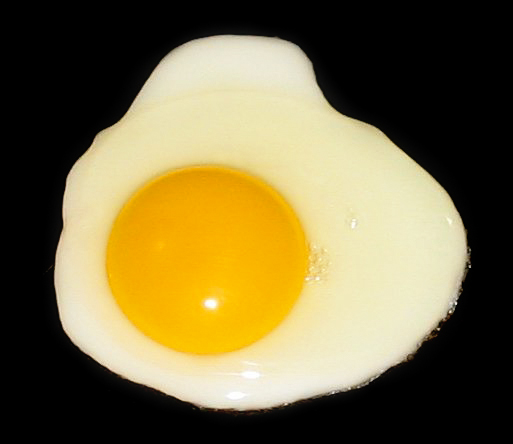
An egg.  I usually make mine over easy, but this is okay too.  Source.
So,

It is all over the headlines recently.  Eating egg yolks is as bad for you as smoking.  An egg yolk is equivalent to five kicks to the groin.  The Ministry of National Defense has begun studying mechanisms by which egg yolks could be weaponised.  Scientists postulate the dinosaurs went extinct from eating too many cholesterol-filled eggs.  For the record, I can't believe that any of these statements would be published, but fire up Google, and see for yourself.  I'd like to give my two cents on the matter, and hopefully offer some clarity to my tens of regular readers (by the by, I'm sure you're looking quite dapper in top hat and shined monocle).

The contention of these articles, and the University of Western Ontario's medical study, is that eating eggs (with yolks), and smoking are roughly equivalent in terms of the damage they do to your arteries.  The primary criticism (and I can't believe only this is the primary criticism), is that eggs and cigarettes damage arteries in completely different ways.  Cholesterol (which eggs contain) causes plaques to build up on arterial walls, while smoking inflames arterial walls.  The effect is ... roughly  the same.  I would like to levy a series of criticisms, if you will allow me.

First, from all the reading I have completed on the subject, as well as a lecture from a chemist on the subject, ingesting cholesterol in food does not necessarily directly affect the amount of cholesterol in your blood.  Many of you may have heard of good cholesterol and bad cholesterol.  This refers to high-density lipoprotein (HDL, "good" cholesterol) and low density lipoprotein (LDL, "bad" cholesterol).  These represent the way that the body moves lipids (i.e. "fats") around in your water-based body.  HDL is called good, because it is the form your body manufactures when it is moving fat to the liver for utilization, so the higher the rate of HDL in your bloodstream, the better.  Within reason, of course.

So cholesterol is involved in carrying fat around in your body.  Does that mean that eating cholesterol will increase your blood cholesterol?  Let's take a quotation directly from Wikipedia.  I am not saying that Wikipedia is infallible, but this statement supports everything I have read on the subject:

"... most ingested cholesterol is esterified and esterified cholesterol is poorly absorbed. The body also compensates for any absorption of additional cholesterol by reducing cholesterol synthesis. For these reasons, cholesterol intake in food has little, if any, effect on total body cholesterol content or concentrations of cholesterol in the blood."

So there you have it, ingesting cholesterol does not directly affect your cholesterol blood levels.  Though, hang on a moment.  The study did find that the ingestion of egg yolks correlates with high cholesterol.  This is a fact, and I will not dispute it.  However, it correlates, meaning egg yolk consumption usually goes hand in hand with high cholesterol.  It does not say that egg yolk ingestion causes high cholesterol, but if it does, it shouldn't.  So, why would this be the case?  Well, the doctors running the study did not bother checking for external factors that may also influence blood cholesterol.  This would admittedly be difficult to do for over 1000 people.  So, here's my hypothesis: perhaps when people are eating egg yolks, they're not just eating what is pictured at the head of this article, perhaps they're eating something that more closely resembles the following.


So maybe, just maybe the blame does not belong to the egg yolks, perhaps it is what is eaten alongside the egg yolks.  Perhaps a patient's blood cholesterol levels are high because of all the extra lipids the body is forced to deal with when one ingests such a feast, and not the cholesterol in the egg yolks.  And maybe the media likes to run with a catchy headline, and might not want to do all the fact checking they should.

So eat eggs [, damn it].  According to wolframalpha.com (a thoroughly wonderful site), two fried eggs have 137 calories, 16% of your daily recommended fat (you do need a certain amount of fat to live well), and 19% of your daily recommended protein.  It's a good start to your day, just not alongside everything pictured above.

NM

P.S.  I swear to various deities, if I hear ONE more person say "Well, first they said eggs were good for you, then eggs are bad, I just don't know what to believe!"  Think critically, and read the full article.  Not just the headline.

P.P.S. Edit on 2013-11-25, link to the article.  What an article.  Though admittedly, I'm just guessing that people who order an egg white omelettes are probably watching their fat intake.  It's a wild, crazy guess. 

Wednesday, September 14, 2011

Vaccinations (incl. MMR)

Source.
So,

I'm not sure if anyone else has noticed this, but it appears that vaccinations have been brought up in the media lately.  I will lead this post with a disclaimer that I know comparatively little about vaccinations (my education has focused on physical science), but I feel that I know enough to write an informed post on the subject.  Prepare yourself for the starry-eyed wonder of a non-life-science type marveling at the human immune system.

I will start off by explaining the routine influenza vaccination, because I assume most vaccinations work on the same principle.  The vaccination itself consists of virus strains which have somehow been stripped of their ability to harm humans (preventing reproduction or harmful traits).  The strains represent different mutations of the influenza virus, the mutations representing different evolutionary strategies of the global influenza population.  Now, these two facts are important because they represent the rationale for most complaints I hear about the vaccine routinely given during flu season.

The most prominent (and baffling, in my opinion), is that "the flu vaccine gives me the flu."  No.  No it does not.  When the human body detects the presence of the influenza virus, it [sometimes] responds by the same mechanism it would in the event of a full infection.  That is to say, fever, aches, runny nose, et cetera.  The body then forms the necessary antibodies to prevent another infection from that specific strain of influenza (this will be important later).  However, rather than flu-like symptoms on week timescales, you might experience it for a day or two.

Another complaint I hear about the flu vaccine is "I got the flu shot, but I still got the flu!  Also, I hate monocles and top hats!"  Now, while the latter half of this statement is no doubt infuriating, take it as an indicator of the quality of person giving the statements.  This problem can represent that the flu shot only protects against ~90% of the influenza strains in the wild, however, it is often due to misattribution of sickness.  The most likely explanation for this is that people get sick with infections not due to influenza, but attribute it to the broadly misused term "flu" (as in "I have a stomach flu" meaning "I have diarrhea", or "I have a 24 hour flu" meaning "I have a short-lived bacterial infection").

Now, to the point of this post.  The MMR vaccine is a shorthand reference for Measles-Mumps-Rubella vaccination which is commonly administered to small children.  A publication in a medical journal The Lancet in 1998 suggested that the MMR vaccine could cause autism in susceptible children.  A dozen papers to the contrary and twelve years later, The Lancet retracted the incorrect article, but the damage was done.  Misinformed (and potentially over-protective) parents everywhere attempt to refuse the vaccination for their children.  This is due largely to parents reading internet articles without thinking critically (but you can totally trust my blog posts, guys!), and the ready acceptance of anecdotal evidence (e.g. But Shirley has a cousin who's uncle's kids got autism from MMR!)

I have also heard the concept of the "free rider" or "herd immunity" hypothesis used in defense of going without the MMR vaccine.  The theory here goes that if a large enough percentage of a population is vaccinated against MMR, those un-vaccinated children are unlikely to contract the disease.  Naturally, this argument breaks down when one considers globalisation, and that these children are the only vulnerable ones in the larger population, and will probably get sick.

My room mate (with a B.Sc. in Health Science), also raises the argument that in the best interest of publicly funded health care, Canada and/or Public Health would not release a vaccination with any known risks or correlations (or at least not without signing a long and wordy contract identifying all risks of the vaccine).  It's a valid argument, especially considering that the Canadian health care system would then be forced to deal with higher health care costs associated with autistic children.

I admit that children go without getting vaccinated because their parents are trying to protect them.  I do not have children, and have not experienced the profound shift in thinking that parents undergo, but I still do not understand the opposing viewpoints on vaccinations.  All I can do is recommend critical thinking when you read.  It's a profoundly rewarding endeavor.

Note: For the record, the leading graph is the reason that children receive the MMR vaccine.
UA-57182519-1