Showing posts with label technology. Show all posts

Thursday, September 18, 2014

A Bigger, Better Canada [MUt3]

We can do it, but we'll have to go North.  Pack your snowshoes.

So,

I've often described Canada's economic system as being "a kinder, gentler capitalism."  We have no doubt benefited from having a dominant superpower and its domestic market as a customer for our vast natural resources.  We have come from a group of fur trappers, loggers and miners to being an advanced economy as well as loggers and miners, thank you very much.  That said, for as much land as we have, Canada is only a nation of roughly 35 million people, leaving us as one of the least densely populated countries on the planet.

Historically, Canada's accomplishments have always looked best on a per capita basis.  We tend to punch above our weight as a people, and has given rise to the functional principle.  We are not a superpower, nor does it currently look like we will be one in the future.  That said, Canada may contend with the world leaders in key functions.  This is evidenced by our presence in things like the G7 nations, and our participation in world leading scientific and technological endeavours.  For example, you may take the Canadian Light Source pictured below.  It is a synchrotron light source (an excellent example of a big science thing).  I could go into the vast technical details, but it is extremely useful in a wide variety of applications from biological imaging to even construction materials.  Canada has one of only a handful in the entire world (which are this good), and it is the best used in the world based on access given to researchers and industrial partners/clients.

The Canadian Light Source, big science thing extraordinaire.

Our accomplishments are many and impressive.  I firmly believe that this is due to our unique combination of capitalism and kindness.  We grew out of a country whose winter alone would kill us unmercifully were we to not work together and take care of one another.  Our social programs help to ensure that many of the economically disadvantaged may prosper and thus contribute to an impressive economy.  Now imagine if there were more of us.  A lot more.

When Wilfred Laurier began his settlement of Western Canada, he envisioned a Canada numbering 60 million.  We... well, your monocles may drop in surprise at this, but we have thus far fallen short.  Currently, a good number to strive for would appear to be 100 million.  For the gaming-savvy, a variety of achievements might be unlocked at this level.  Canada's density poses a problem, because our markets are so few and far between and building the infrastructure to go between these urban centers is cumbersome and costly.  Militarily speaking, it also means that large sections of the country could be conquered by simply marching through it.  Services like health care and even internet in some cases are hard to deliver because there isn't enough of a market to warrant building the facilities.  Even economically, we have a very limited domestic market when you consider our economic output.  When a Canadian company wants to make something, it has to ensure that someone else will buy it.  It is hypothesized that a domestic market of 100 million people would begin to make us more independent of the rest of the world, and a people as economically prosperous as us would make for excellent consumers.

We are heavily concentrated at the bottom of our country, apparently clinging to the United States.  The article from the Globe and Mail linked in the paragraph above (and here, if you're lazy) makes excellent points on the matter, but I feel it falls short on an action plan.  The suggestion is that we massively boost immigration before developing countries reach economic prosperity and begin to experience shrinking populations.  These new Canadians would then go to existing cities, achieving a density which would alleviate our problems of sprawl and unlock tax bases which could fund truly inspiring projects.  However, this still leaves our major urban centers few and far between, and there's also the issue that these new Canadians would need something to do.

 To the north of our largest settlements, there exists mid-Canada.  It is not the far North, where trees refuse to grow and you have to be wary of the bears.  It is not the South, where the factories thump and farms flourish.  It is a land south of the permafrost, rich in natural resources and potential.  It is a vast corridor of potential wealth waiting to be unleashed.


As a centennial project [from which I am heavily borrowing], researchers at Lakehead University suggested the "Mid-Canada Development Corridor."  This has happened if only to a small extent in the intermittent period.  Fort McMurray is an example of what the corridor could offer, but larger and more extensive.  The idea would be to establish permanent settlements along mid-Canada that could take advantage of several natural resources to provide a diverse economic base and fuel development before other economic activities arise.  The hope would be that these larger communities would follow the example of settlement in Northern Ontario.  Roads were installed, logging camps were made which cleared out land and created income, eventually developing into permanent settlement.  Our nation's capital, Ottawa, originally started as a logging settlement.

This region of Canada is currently short on roadway coverage.  That said, there is good air and rail coverage.  This means that people may be carried by air until roads catch up, and there appears to be an extensive rail network which can provide efficient rail freight transport.  The majority of this corridor is the Canadian Shield and is rich in a variety of minerals as well as untapped hydroelectricity, which has a fantastic EROEI and would do very well for fueling both development and potentially the smelting of ore.  The only real exception to this is the Tundra and Northern Alberta and Saskatchewan, where the primary resource are oil, natural gas, or both.  As an interesting note, it was proposed that these settlements could follow the example of Siberian communities which have gas-heated greenhouses to supply fresh produce in the winter.  That said, with enough timber around it might be easier to use rocket mass heaters for those greenhouses.

By developing this corridor, Canada would unlock both vast swaths of natural resources which currently sit untapped, as well as the pseudo-magical 100 million tax base to further fuel our development.  Remote communities would not be so remote, and could be better served.  Perhaps some countries would take our claims to the our Arctic archipelago more seriously.  Better yet, if our per capita wealth keeps pace as we continue to nurture and encourage every single Canadian, we could become an economic heavyweight and become a major player on the world stage.  A nation as great as ours basically owes the world more Canadians.  And then there's the fact that we already produce the world's best hockey players, and a larger population would allow us to be even more selective.  Think of the hockey.

If nothing else, think of the hockey we could have.

NM

Update (2014-09-22): Part 2 of my Mid-Canada Ramblings may be found here.


N.B.  This may end up being a living document for a couple days.  I keep forgetting to add important details.

Friday, November 4, 2011

Coffee.

A cup of coffee, served "black."  Source.
So,

I have long thought that I should write a post on my most beloved of beverages (but please don't tell Beer, Gin or Vodka, that's an awkward conversation I'm not ready to have), and, in typical fashion I have been bogged down thinking about how to properly explore it as a topic.  Whilst I may edit or otherwise reconstruct this post in the future, I shall dive in and attempt to share my interests.  I hope that you, my dearest, non-spambot reader will enjoy it all the same.

A brief aside: As always, my claims will be formally unsubstantiated, but I trust that a consultation with Google will either support or refute me.  If you do notice an error, please comment such that I will be able to remedy the situation as transparently as possible.

My historical knowledge of coffee is somewhat lacking, but I do recall a couple notes of interest.  It is said that coffee's rise was due in no small part to that of Islam.  While the consumption of alcohol was forbidden by the faith, coffee was seen as an acceptable substitute (must like cocaine-laden beverages were in the USA during prohibition).  In stark contrast, some European coffee-houses were banned in the 1600-1700s (universally in some countries), due to suspicions that they were used to conspire against the local monarchies.  For various reasons, a non-trivial contribution being the deliciousness of the beverage, I am certain, coffee persisted and became the beverage I know and love today.

The coffee plant persists only between the tropics of Cancer and Capricorn, an area which may be known as the "Coffee Belt".  The plant naturally grows largely in the shade of larger plants and on slopes, likely for drainage.  When you see coffee labelled as "organically shade-grown", this is to what they refer.  It is my understanding that this is the Arabica coffee which we drink.  The other variety, Robusta, was largely developed for the purposes of serving humanity's likely unhealthy dependence on the stuff.  Robusta coffee will grow in (on?) traditional cropland in full sun, but ultimately results in a poorer quality product.  At this point, I shall digress and recall a commercial for Nabob coffee.  The gentleman featured in the commercial detailed how much coffee was shade grown, how much was sustainable/fair trade/what-have-you, and said that of that shade grown/fair trade/what-have-you, Nabob beans accounted for only 10%.  He then smiled and asked that we make it 100%.  Terrible, I declare.  He should simply wish that sustainable/fair trade/what-have-you beans will become a larger share of total bean production, and potentially wish that Nabob will represent a larger portion of the aforementioned beans.  I cannot imagine why he would wish a monopoly on S/FT/WHY [interesting that "what have you" becomes WHY, I digress further] if he truly cared about sustainability.  But anyway...

The fruit of a coffee plant.  Source.
After the coffee has been grown, it must be roasted.  I am given to understand by an excellent comic by The Oatmeal on the subject that the green bean at the centre of the fruit will pop twice upon roasting.  The second popping of the bean indicates that it has finished roasting.  I assume it is at this point which "light" roast coffee beans are removed.  It is my understanding that the duration of roasting determines light v. dark classifications, as well as those in between.  It also determines the concentration of caffeine in the coffee beans.  Caffeine will undergo thermal degradation at roasting temperatures, so light roasts contain more caffeine than the dark counterparts.  Therefore, if one desires caffeine most from their coffee, one would chooses a light roast.  Alternatively, if flavour is paramount for a drinker, one would choose a dark roast (a wonderful example being the Continental from Second Cup).

Once the bean has been chosen, one must choose the grind and brewing method.  These go hand in hand, as the grind is determined by the time water will be in contact with the grinds.  In North America, we tend to use a grind labelled "coarse" and use a drip brewing method.  Here, water is heated to near its boiling point and dripped over coffee grounds housed in a basket.  The resultant extract of the coffee beans drips out the bottom of the basket and into a carafe.  The machine is relatively simple, requires little thought and, perhaps most importantly, is difficult to screw up.  This last feature is incredibly important when one considers that many of us are largely useless before the coffee has been brewed [in the interest of full disclosure, I am always vigilant in finding new and exciting ways to screw up the morning coffee].

The Bodum has enjoyed recent popularity, and is a method of coffee preparation utilizing a French press.  Freshly boiled water is poured over very coarsely ground coffee and kept there for several minutes within the cylindrical vessel.  Afterwards, a [metal grate] plunger is lowered which holds the grounds at the bottom, and allows the brewed coffee to be poured from the top.  I am told the finished product is rather nice, but I have never enjoyed coffee prepared with a French press.

An espresso maker with crema shown.  Source.

While the above two methods are really two ways of making brewed coffee, a slightly different product is espresso.  You will note this is not "expresso", but espresso.  I have often described this method as the end product of an engineer trying to make concentrated coffee.  It is as labour intensive as it is lovely.  One must use a very fine grind of coffee [the water is in contact with it for a very short time] and tamp it into a metal basket [using a tamp, able to press the grinds into the basket evenly].  YouTube videos recommending using roughly 30lbs of weight behind the tamp.  This basket is placed into a holder, which is then locked into the espresso machine.  In my personal machine, steam at ~15 atmospheres of pressure forces water into the basket, allowing the brewed espresso to flow through a pinhole at the bottom of the basket.  The shot is "pulled" for roughly 15-20 seconds before it is stopped.  At this point, the crema [with an accent so the e makes an "ay" sound] should be even, off-white and delightfully foamy. It is worth noting that espresso-ground coffee must either be purchased directly, or ground with a burr grinder.  A regular coffee grinder using a blade will not produce a fine enough particulate size for espresso.  A burr grinder is not unlike a mill stone with sharp burrs attached, and it may also be adjusted to allow for normal "coarse" grind coffee, or the very coarse grind required for French press brewing.  In a fun physics note, when grinding coffee to the finest of grinds, static charges result.  Then, when a very tired operator opens the vessel containing the grinds, they have a tendency of flying everywhere, the static forces easily overcoming gravity for small particles.

Naturally, with human beings consuming coffee the way we do, the health effects of ingesting this brew is continuously studied.  I shall not begin to speculate on all the potential benefits that have been preached, both because I feel I have not read enough into the possible decreased risk of Alzheimer's, prostate and other diseases.  Instead, I will touch on a few interesting notes which I have come across.  Regardless what health benefits one may be chasing [it is touted as having lots of antioxidants, among other things], one must be careful not to consume much more than three cups per day.  Too much caffeine will stress the human body, and ill health will result.  That being said, one may note that a lot of coffee is consumed by those who are thinking during work.  This is due to the fact that caffeine has been found to inhibit the chemical pathways which cause fatigue after mental exertion.  Not only that, but it has positive effects on physical performance as well.  In fact, Cracked has produced an article detailing the super powers bestowed upon mortals when they consume coffee.  Just try to keep it under three cups a day.

The benefits of consuming coffee lead me to wonder whether it is to us what Freud thought cocaine would be.  Freud was a large advocate of cocaine, thinking it a cure-all, and extolling other virtues.  I believe a couple were increasing chattiness and rosiness of the cheeks.  He only stopped when he saw how cocaine destroyed lives.  When working at a rather slow-paced job, I drank an awful lot of coffee. In some ways, I actually fit symptoms of drug dependent behaviour.  My sleep patterns suffered, and I was generally moody and irritable, likely a byproduct of stressing my system too much with caffeine.  Cutting down my consumption was difficult, but unlike with cocaine, my life was not at risk in doing so.  Maybe Freud was right, but he had the wrong substance.

It would seem that what was meant to be a brief discussion of coffee has become drawn out and rambling.  In any case, enjoy your coffee tomorrow.  I know I will.

NM

Wednesday, September 14, 2011

Vaccinations (incl. MMR)

Source.
So,

I'm not sure if anyone else has noticed this, but it appears that vaccinations have been brought up in the media lately.  I will lead this post with a disclaimer that I know comparatively little about vaccinations (my education has focused on physical science), but I feel that I know enough to write an informed post on the subject.  Prepare yourself for the starry-eyed wonder of a non-life-science type marveling at the human immune system.

I will start off by explaining the routine influenza vaccination, because I assume most vaccinations work on the same principle.  The vaccination itself consists of virus strains which have somehow been stripped of their ability to harm humans (preventing reproduction or harmful traits).  The strains represent different mutations of the influenza virus, the mutations representing different evolutionary strategies of the global influenza population.  Now, these two facts are important because they represent the rationale for most complaints I hear about the vaccine routinely given during flu season.

The most prominent (and baffling, in my opinion), is that "the flu vaccine gives me the flu."  No.  No it does not.  When the human body detects the presence of the influenza virus, it [sometimes] responds by the same mechanism it would in the event of a full infection.  That is to say, fever, aches, runny nose, et cetera.  The body then forms the necessary antibodies to prevent another infection from that specific strain of influenza (this will be important later).  However, rather than flu-like symptoms on week timescales, you might experience it for a day or two.

Another complaint I hear about the flu vaccine is "I got the flu shot, but I still got the flu!  Also, I hate monocles and top hats!"  Now, while the latter half of this statement is no doubt infuriating, take it as an indicator of the quality of person giving the statements.  This problem can represent that the flu shot only protects against ~90% of the influenza strains in the wild, however, it is often due to misattribution of sickness.  The most likely explanation for this is that people get sick with infections not due to influenza, but attribute it to the broadly misused term "flu" (as in "I have a stomach flu" meaning "I have diarrhea", or "I have a 24 hour flu" meaning "I have a short-lived bacterial infection").

Now, to the point of this post.  The MMR vaccine is a shorthand reference for Measles-Mumps-Rubella vaccination which is commonly administered to small children.  A publication in a medical journal The Lancet in 1998 suggested that the MMR vaccine could cause autism in susceptible children.  A dozen papers to the contrary and twelve years later, The Lancet retracted the incorrect article, but the damage was done.  Misinformed (and potentially over-protective) parents everywhere attempt to refuse the vaccination for their children.  This is due largely to parents reading internet articles without thinking critically (but you can totally trust my blog posts, guys!), and the ready acceptance of anecdotal evidence (e.g. But Shirley has a cousin who's uncle's kids got autism from MMR!)

I have also heard the concept of the "free rider" or "herd immunity" hypothesis used in defense of going without the MMR vaccine.  The theory here goes that if a large enough percentage of a population is vaccinated against MMR, those un-vaccinated children are unlikely to contract the disease.  Naturally, this argument breaks down when one considers globalisation, and that these children are the only vulnerable ones in the larger population, and will probably get sick.

My room mate (with a B.Sc. in Health Science), also raises the argument that in the best interest of publicly funded health care, Canada and/or Public Health would not release a vaccination with any known risks or correlations (or at least not without signing a long and wordy contract identifying all risks of the vaccine).  It's a valid argument, especially considering that the Canadian health care system would then be forced to deal with higher health care costs associated with autistic children.

I admit that children go without getting vaccinated because their parents are trying to protect them.  I do not have children, and have not experienced the profound shift in thinking that parents undergo, but I still do not understand the opposing viewpoints on vaccinations.  All I can do is recommend critical thinking when you read.  It's a profoundly rewarding endeavor.

Note: For the record, the leading graph is the reason that children receive the MMR vaccine.

Sunday, August 28, 2011

Genetic Algorithms.

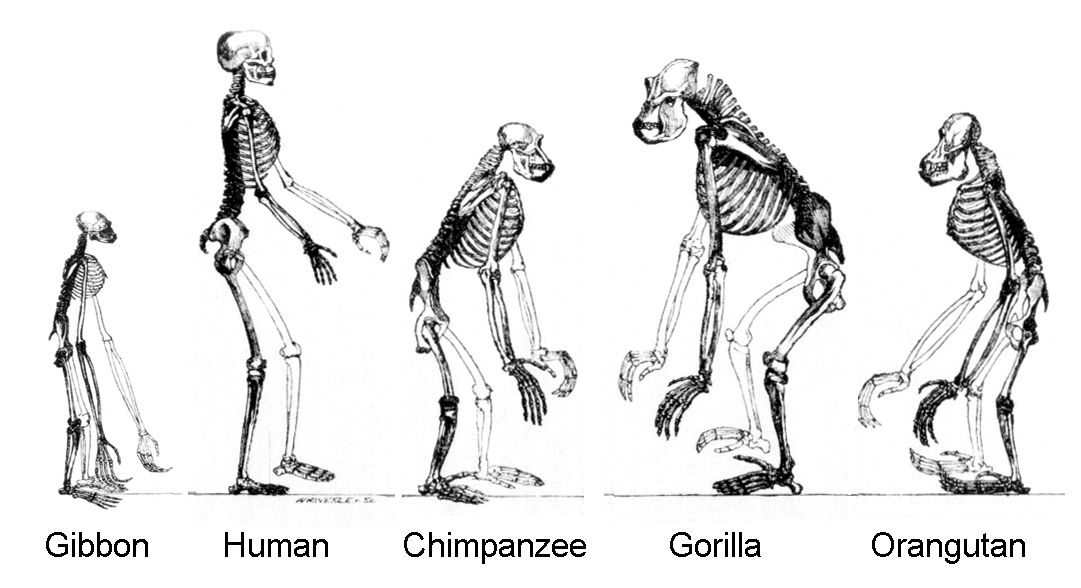
The hominoids evolved from a common ancestor.  Source.

So,

I have been thinking a lot about genetic algorithms lately.  The idea was introduced to me here, where I lost many an hour watching cars evolve to fit different tracks.  I later saw it being used in the lab where I did my honours thesis, with a peer attempting to design better fuel cells.  Perhaps I shall start with an explanation of what exactly these genetic algorithms (GAs) are.

A GA seeks to mimic the natural evolution that we see in our day-to-day life on Earth.  Take for example how we humans reproduce.  We are produced via sexual reproduction, we get half our chromosomes from our mother and the other half from our father, called "crossover" in terms of genetics and GAs.  After random mutations (which GAs also utilise), we are essentially a genetic experiment.  We have a fairly high success rate currently due to the societies we have built, but in earlier eras survival was not necessarily the virtual guarantee it is now.  Should the organism survive to procreate, it is largely considered a success.  The better the individual, the better the chance of this success.  Therefore, with increasing number of generations, the "good" traits we inherit from chromosomes should come to predominate in the larger population, since ideally those individuals with "bad" traits are less likely to succeed and procreate.

Life, in our case, is the equivalent of a "fitness function" for GAs.  Life determines fitness of individuals by killing off or making the less successful crossovers less likely to breed.  In terms of computers, the fitness will be evaluated based on what the scientist wants to accomplish with the algorithm.  The boxcar example above evaluates the fitness of cars based on how far they get on a given track, and how fast they do it.  A selection process then chooses breeding pairs to create the next generation (with the most successful individuals very likely to reproduce).  Naturally, crossovers of fit individuals does not guarantee fit offspring, but it becomes increasingly likely as the population will "converge" to a solution for a given problem.

Sunlight.  You'll understand if you read the next paragraph.  Source.

By now, my dear reader, you must be wondering what on Earth can be accomplished with a GA.  The answer, really, is whatever you want it to.  A video of a TED talk by Bill Gross was my inspiration for this post.  Bill Gross decided that he wanted to design a solar energy solution using mirrors and Stirling Engines, and he used a GA to do it.  He designed the computer to utilise chromosomes based on mirror pieces in three dimensional space (presumably with random placement and orientation), and with enough time, the GA gave what it felt to be the best solution based on the fitness function used (it sought to maximise the hours of sunlight the device would be useful for).  I highly recommend watching the video, at least so that one can view the results, which are truly remarkable.

The strength of GAs is that, so long as they utilise a good fitness function, they can come up with solutions a human engineer might never come up with.  Perhaps we as humans would think of these solutions with enough time, but we are creatures of habit.  Computers, given enough degrees of freedom, can come up with truly remarkable solutions without the bias towards existing solutions that we humans may exhibit.  These solutions often represent the convergence of an entire population within the computer to one design.  It is just as we humans have come to where we are today through genetics and evolution.

Arguably the most fascinating aspect of GAs is that we are not exactly certain why they work.  There exists no theorem or mathematical proof which would explain why a GA would ever be a good solution.  Additionally, the solutions generated by GAs often catch scientists off-guard.  They look strange and new to us, but must be a good solution, as they have already been tested under the constraints of the fitness function.  Bill Gross, too, was surprised to see what his GA had developed, and like other scientists, had no idea how it had come to such a conclusion.  The only reason we have to think GAs will work is the large GA experiment we see around us, commonly known as life.

As a result of all of this, I have found myself wondering where else GAs could improve our lives.  I also think I could utilise a GA to select a fantasy hockey pool team, a thought that titillates me to no end.  I'm not sure I've done the best job of explaining GAs here, but I hope I've piqued your interest enough that you will do some reading of your own.  It's truly wonderful stuff.

NM

Thursday, August 25, 2011

Garbage Incineration.

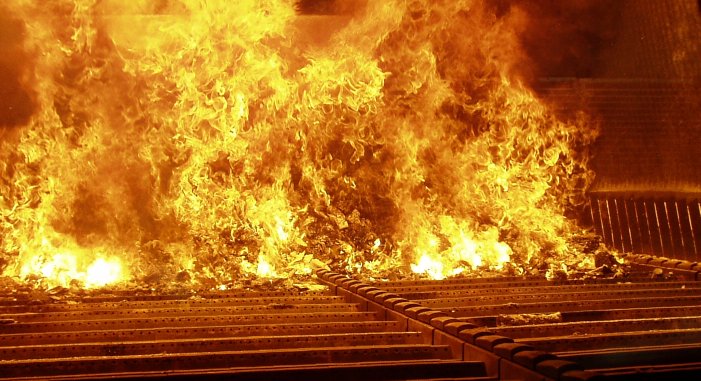
Municipal waste being incinerated.  Courtesy Wikipedia.
So,

It would seem that there is some kerfuffle in the Greater Toronto Area.  The ground has been broken on a garbage incinerator project, and the locals are certainly worked up about it.  While I will not pretend to be an expert on the subject, I do know some pertinent science that I am sure you, my monocled, Brandy-swirling readers would love to hear about.

I will freely admit that at first, burning garbage seems like a bad idea.  After all, many of us have thrown things onto a fire and seen the evolution of black pillars of foul-smelling smoke.  This, however, is far different from what goes on in a garbage incinerator.  You see, inside an incinerator, it is much easier to get up to high temperatures in an enclosed space than in an open fire pit.  Those of you who have used a chimney to ignite charcoal (or "cookin' biochar", as I am certain no one calls it) may be familiar with this effect.  The objective here is to achieve total combustion, where all carbon [or fuel, the garbage] is fully converted to carbon dioxide ["is fully oxidised"].  This is far better for our air than the results of impure combusion, which include much higher amounts of ash, soot [what I assume to be aerosolised/dispersed ash, really], and harmful products like carbon monoxide.  Fire pits see impure combustion when "smoky".  The combustion above appears to be very pure, by comparison.

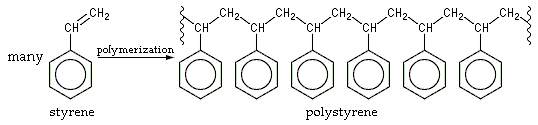
The structure and synthesis of polystyrene. Wikipedia.

I will also admit that, in many cases, garbage incineration is often accompanied by the abandonment of recycling plastics.  They are necessary to fuel the blaze, and are included with the garbage.  This, too, sounds like a nightmare to the environmentalist.  I agree that in a perfect world, all plastic would be recycled forever.  Sadly, this is either not the case, or not possible.  Some classes of plastics would be easy to recycle.  Styrofoam, polymerized styrene [or "polystyrene"] is an example.  This is easily dissolved in the solvent acetone.  Acetone also has a very, very low boiling point.  It would be very easy to dissolve all those meat trays and packing chips, then boil off the solvent to have relatively unscathed polystyrene to reuse.  Unfortunately, as with other classes of plastics (water bottles, especially), this is not the case.  The manufacturing process for these types of plastics is inexpensive enough that the recycled product is too expensive for anyone to purchase.

The other challenge facing plastic recycling is the nature of the substance.  As can be seen above, plastics [polymers] are very long chains of some individual molecule [the monomer].  The recycling process must heat plastic so that it can be reformed.  Heating damages the bonds of the polymer, causing the plastic to degrade.  In fact, the reason that one rarely sees 100% recycled plastic products is that the structural integrity of recycled plastic is compromised, and it must be blended with new plastic so that the product may serve its purpose.  For the record, recycled metal does not share this problem, and I think it a fabulous idea, given the environmental costs of smelting metal.  Metal is also easily recovered in the incineration process.

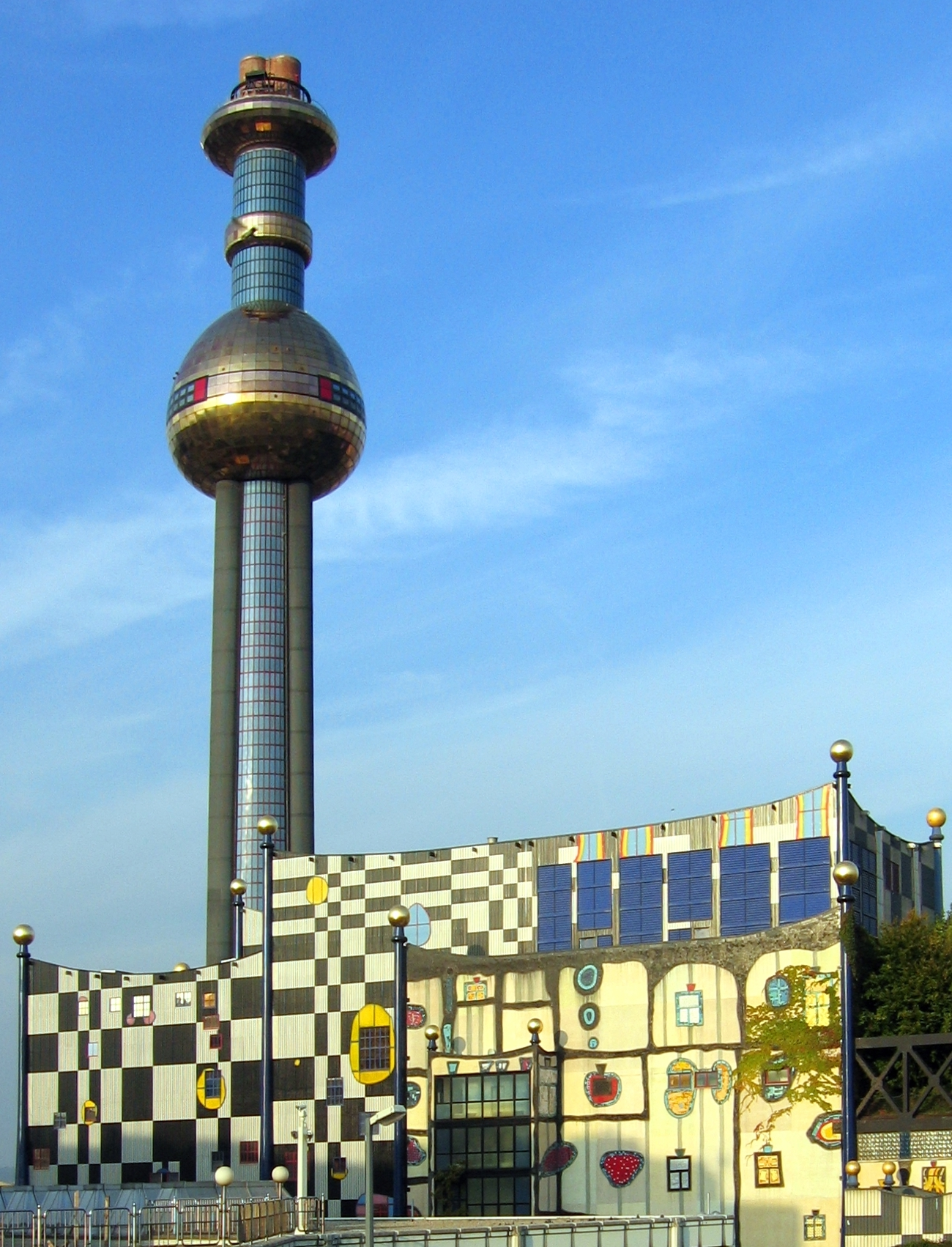
A garbage incinerator in Vienna.  Source.

"Now see here!" You may demand.  "Won't this contribute to global warming?  Spewing out all that carbon dioxide?!"  This is an excellent point, and I am glad that you [might have] raised it.  It is true that greenhouse gas emissions will be added to with garbage incineration, however, it is much better than other emissions associated with dumps.  You may have seen torches burning outside of buried garbage dumps.  I know that I have near Carp, Ontario.  The reason for this is the venting of methane, a common byproduct of garbage disposal.  A methane leak is far, far worse than the leaking of carbon dioxide into the atmosphere.  The reason can be explained with very simple physical chemistry and math (you may skip the next paragraph if you are truly averse to it, though I find it interesting).

The surface of the Earth is heated by the Sun.  As can be seen in math here, the light that an object emits depends on its temperature.  The very hot Sun emits all colours of the rainbow, but the Earth is by comparison only lukewarm.  Objects at that temperature emit infrared (IR) radiation (this is how night and thermal cameras work).  Normally, a substantial amount of heat from the Earth is converted into IR and is lost to space.  Molecules, however, will absorb IR and begin to vibrate, blocking the exit of the heat into space.  This is the cause of the greenhouse effect.  Now, not all molecules are created equally.  The amount of IR that a molecule can absorb depends on how many ways that molecule can vibrate, known as vibrational modes.  The number of vibrational modes of a molecule depend only on the number of atoms.  Carbon dioxide has three atoms, and linear molecules follow the formula 3N-5, meaning it has 4 modes of vibration.  Non-linear molecules have 3N-6 vibrational modes, giving methane, a 5 atom species, 9 modes of vibration (or something like that).  Other math which I do not wish to get into demonstrates that this makes methane 21 times worse to have in the atmosphere than carbon dioxide.

We must also consider the issue of storage.  Many municipalities are running out of space for garbage, and it is much easier to bury the remaining ash of an incinerator than it is for the immense volume it started as.  Also, while most modern dumps are more or less sealed, leaks of contaminants are not impossible.  Many contaminants released by the incineration process can be captured before discharge into the air, meaning that, in my opinion, it is likely safer to incinerate garbage than it is to simply bury it.
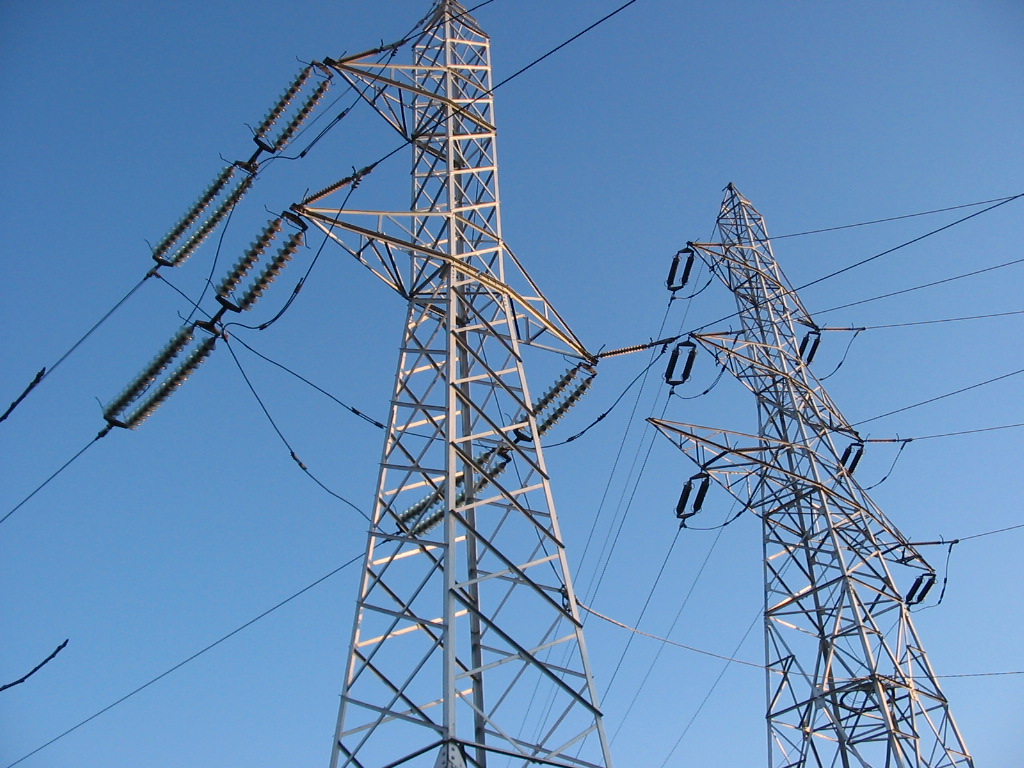
Power transmission lines, because I discuss it below, and this certainly is a large block of text.  Source.

I must also discuss the issue of power.  Conventional dumps may use the methane generated by the garbage to spin a turbine and generate power, which seems like a fantastic idea.  Energy from our waste. However, garbage incineration offers a much higher amount of energy to us.  The fire from the incinerator can be used to generate steam from a boiler.  This would spin a turbine in exactly the same way as nuclear, coal and natural gas power plants do, but from a power source we are currently wasting. In a twist on this idea, a company called Plasco has found that heating and exposure to a plasma torch can produce refined syngas (mentioned previously in my biofuels post), which can then be used to make various other products and fuels.  It is also worth noting that steam-generating applications can route waste heat to nearby schools and hospitals to heat hot water, boosting the overall efficiency of the process.

With this in mind, I feel that garbage incineration is beneficial, and ultimately an opportunity.  It would lead to safer disposal of our waste, which is inherently invaluable.  Further, it represents an untapped energy source which could ease strain on our grid, and provide baseline electricity generation which most renewable fuels cannot (as the sun does not always shine, nor does the wind always blow).  I think that, if done properly, widespread incineration efforts would lead to a better tomorrow.

NM

Monday, July 11, 2011

Patents in the IT world.

So,

It seems that the auction for Nortel's patent portfolio is over.  It appears that the patents were awarded to a consortium which comprises Apple, Microsoft, RIM and Sony among others with which I am not familiar. This has led to accusations that these companies worked together in order to keep the patents out of Google's hands, in order to cripple development of Android.

"But how?" I assume you demand, while adjusting your monocle, and almost spilling some fine spirits upon which you are surely sipping.  This is, I assume, how all non-spambots read my blog (you know, if there were any).  You see, innovation in the tech world is a peculiar beast.  Innovation works best by building upon the existing body of knowledge.  However, this is impossible to do legally when parts of the existing body are patented.  Now here's the catch: everyone does this.  All technology firms which innovate use patented ideas which they themselves do not own.  They do this by building large portfolios of existing patents, buying them from other companies.  This way, should one technology giant sue another for patent infringement, they would themselves face a large countersuit for patent infringement.  This allows for de facto free innovation.

Unfortunately, not everyone is playing nice.  Apple has been overly litigious in recent years, targeting relative upstarts like HTC.  This sort of action is particularly frustrating, especially when one considers that the very idea of a graphical user interface (GUI, or something that isn't a command line), is patented.  I believe it was first developed by Xerox.  In short, they are all stealing the ideas of others, and it is unfortunate that Apple would stunt development by targeting firms which do not yet have large reserves of patents for countersuits.  That being said, it appears all the major players are attempting to stunt Android by denying Nortel's patents to Google.

Speaking from a business standpoint, it makes good sense to block Google.  Android is an open-source project, making the use of the Android operating system essentially free of charge.  This means that rather than paying licensing fees for something like the mobile Windows operating system, technology firms and developers can use Android.  Economically speaking, this means that the Android market share should explode in fairly short order.  Of course, this could be curbed by denying Google a patent portfolio and stunting development of Android.

For the record, I am not against all patents.  It is my understanding that drug companies, in particular, need the patent system to recoup the years of research and development necessary to make a new drug.  Despite what you might hear on television (I remember a rant on an episode of House on the subject), drug companies run a precarious balancing act at times.  Merck-Frosst, a pharmaceutical giant, was almost bankrupt when Vioxx failed.  Now, Vioxx should not really have failed.  After Merck pulled Vioxx from the market due to patient deaths, it was revealed that the problem was due to said patients exceeding the recommended dosage of the drug.  However, the damage was done, and Merck had to absorb the costs of the R&D of Vioxx.  It almost didn't happen.  A pharmaceutical giant was almost destroyed by the inability of patients to follow instructions.

I suppose if it were up to me, a new system would be developed for IT patents which would allow for free innovation, but would protect companies from legitimate theft.  Mind you, I am sure I am not the first one to propose this, and I am certain greater minds have put their efforts forward, so it mustn't be easy.  I use Android, I like it and hope it succeeds.  I suppose I can also hope that the technology giants will play nicely.  It may be a long shot, but we can always hope.

NM
UA-57182519-1